
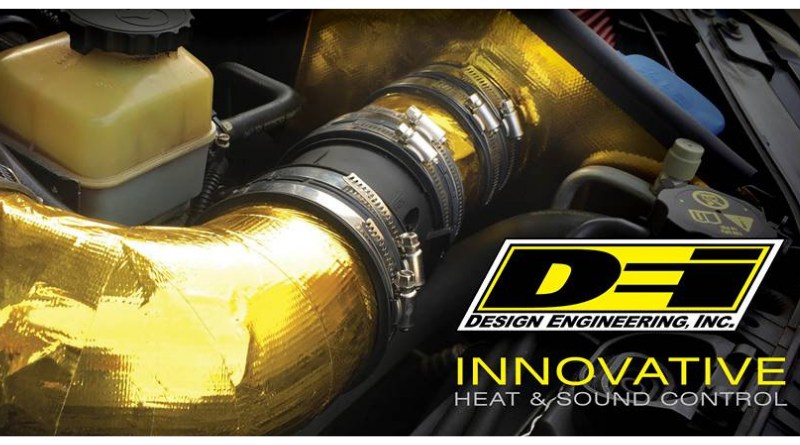
Keep it Cool with DEI Heat and Sound Insulation
Everyone loves to talk about the “sexy” stuff when it comes to real auto parts. Wheels and tires, cylinder heads, cams and valvetrain, fuel delivery, lift kits, lowering kits—you get the picture. While go-fast and look-cool add-ons give a vehicle potential (and some bragging rights), it’s the little things in between buttoning everything up that often make the ride enjoyable. Largely because, they’re the things keeping the ride going at all.
Look, whatever you’re currently building, be it classic or late-model, street or strip, you’re going to run into some issues—both in the garage and on that first (or fourth) test drive. It’s inevitable. Why? Because things get hot. That metal box running on explosions is giving off some serious heat, ya know? And if you’re like me, you forget about this from time to time.
I don’t care if you’re running Ford, GM, or Mopar: you’re going to have wires that run too close to the headers, heat coming from the floorboards, or wire looms and other cheap pieces of plastic burning up on you. Luckily, combating all this unwanted extra heat (and offering a little sound deadening in the process) is Design Engineering, Inc. (DEI) and its seriously impressive lineup of heat and sound insulation products.
So, who exactly is DEI?
As I was researching what’s new with this product line, a friend of mine (and fellow gearhead) called me. When I mentioned what I was working on, he enthusiastically replied, “Awesome product, I love it.” This then led to a solid 15-minute conversation on why we love DEI. (Dudes, right?)
It’s a brand we use. It’s a brand we regularly depend on. And, most importantly, it’s a brand whose products are vital to the reliable performance of your ride.

Founded in 1995, DEI was the brainchild of Dale Markley and his wife Nancy. The original vision for the company was to develop solutions for the racing and performance industry’s struggle with heat issues. And what started as little more than a shop in Cleveland, Ohio, steadily grew into the most reputable brand in automotive heat and sound insulation.
While you might not always find DEI product splayed out under the hood of show cars and trucks, if you take a closer look under the carpets, on the headers, or even against the firewall, you stand a good chance of seeing them. And if you hit the race track of any sort—you’d be hard pressed not to find this brand’s product under the hood.
What does DEI bring to the table?
Heat and sound insulation can be wrapped up into one blanket statement, but to truly understand why these products are important, we should take a closer look at the applicable uses for them.
Sound deadening is easy enough to understand. As you drive down the road, rocks, vibrations, bumps, and exhaust notes can become a problem. Being able to hear the radio, passengers’ conversations, or simply enjoying a little peace and quiet can become compromised. That’s why DEI offers sound control products like noise barriers and absorbers, damping materials, speaker baffles, and headliners.

But sound isn’t the only thing that can travel through the firewall and floor pans. Heat from the engine bay and transmission can pollute the cabin, as well. In the cooler months, this might actually be enjoyable—but in the dead of summer, it can become downright unbearable, leaving you a sweaty mess as you try to enjoy your hotrod. DEI’s lineup includes heat reflective sheets, floor and tunnel shields, and Boom Mat spray to combat unwanted heat.
Additionally, headers heating up the engine bay can boil fuel, burn wires, and even hurt performance. And it’s not just headers under the hood complicating heat management. That’s why DEI also offers protective wraps and sleeves for wires, fuel lines, starters, and turbos. Really, virtually anything mechanical under the hood can be protected by DEI.
So what’s new?
What I respect about this brand is the way it continues to innovate new solutions. (DEI even makes dyno strap heat guards!)

In fact, some new product is application-specific, like the company’s new Corvette Cooler line covers, converter plate, trans tunnel kit, and EGR pipe covers or its LS Engine Coil Pack Heat Shield, which eliminates the need to relocate coils packs and prevents premature coil failure due to overheating.
DEI even carries product for small-but-growing market segments. Recently added, is a comprehensive, custom cut, 11-piece kit for the Polaris Slingshot. With a double-walled main heat shield, a single-walled floor pan heat shield, and several additional precision-cut pieces, this kit helps block heat and sound coming from the transmission tunnel and console. Also new, is a heat and sound insulation kit for the Mercedes Sprinter Van. Blocking out road noise and cold weather, this is a great solution for those who work—or live—in their Euro van.
DEI continues to pump out universal product as well, like muffler kits, coil pack covers, titanium header wraps, and even a muffler cover for golf karts. I think the new product that I can’t wait to try out, though, is this new oil rug which is designed to catch, contain, and absorb oil spills.
Are heat and sound insulation THAT Important?
I get it, this product isn’t free and if you’re wrenching on a budget, you might feel that heat and sound insulation products are an unnecessary expense. But consider that this is more than just comfort and style on the line—we’re talking about performance and reliability.
Shorting wires on the header? Sure, you should have chosen a better route. But maybe you weren’t left with a choice or something unforeseeable occurred. And when those wires melt, you’ll have to replace them—which is money out of your pocket. While in your driveway or shop, this may not sound like a big deal. But fry them on the side of the road without your tools and you’re in need of a tow ride that’s going to easily top $100.
And what about vapor lock? Older cars weren’t designed to run with ethanol-enriched fuel, which has a lower boiling point. Letting heat radiate under the hood can easily boil fuel in the lines and carburetor, leaving you with a vapor-locked engine that eventually breaks down. Then you’re stuck waiting until the thing cools down so you can hopefully make it home or repeat the process until you reach your destination.
Truly, I can continue, but I think you see where I’m going here. Yes, DEI heat and sound insulation products are worth the investment. In my opinion, anytime you’re building something, you should keep one of their catalogs nearby to flip through and brainstorm. Proactive steps cost a whole lot less than mistakes. And, in my experience, DEI products are a major help in preventing costly heat issues—with the added bonus of a quieter ride.


