
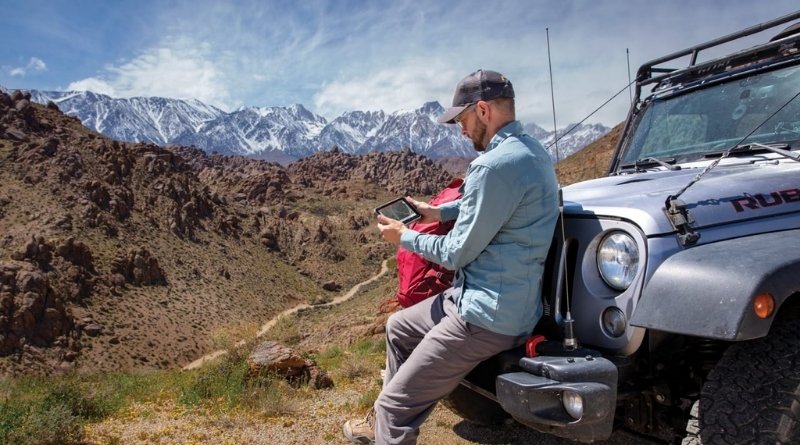
The Resourceful Traveler: Overlanding GPS Units for Stress-Free Navigation
In a previous Resourceful Traveler article, we shared some of the best adventure apps available for your iOS and Android devices. Apps like iOverlander and Gaia GPS stood out as hands-down our favorite navigation tools for when the pavement ends and the real journey begins. While your phone is an irreplaceable piece of kit, though, we don’t think it should be your only source of maps. Enter: Overlanding GPS units.
“It’s not 2002 anymore. I have a smartphone with overlanding apps and Google Maps; why do I need a physical GPS unit?”
That’s a good question – and one you may have thought upon discovering this article. There are several reasons why a standalone GPS is a great choice.
Benefits of Using Standalone GPS
Service
Back at the turn of the century, it was a common thought that by 2020 there would be no place on earth (or at least the United States) where you’d couldn’t get a cell signal. We imagined a world where you could travel to the ninth circle of hell and still have enough service to update your top 8. Well, I hate to tell you this past self, but MySpace is no more. Worse, your mobile phone doesn’t work everywhere.

If you’re camping, hiking, or overlanding, chances are high you’ll be more than a stone’s throw from civilization. And that NO SERVICE message? It becomes much more frequent. You can download as many offline maps as you want before the journey, but unless you know the location of every footprint you’ll be making, it’s foresight very few of us have. Overlanding GPS units eliminate the need for this soothsaying. They use satellite signal, which is much more prevalent as well as accurate.
Easy to Power
In addition to powering your navigation app, your phone needs to…well…do phone things. It runs apps, searches for cell signal, sends texts, and streams that Nu Metal playlist your campmates are already tired of. GPS units have one job, so battery is sipped rather than gulped.
Sure, there are some newer vehicle-centric units that pack a ton of features and are meant to be used while connected to power, but many overlanding GPS units offer several methods of charging. They also offer superb battery life when compared to your mobile.
Durability
While we admit that there are some pretty beefy phone cases out there, a GPS tracker is purpose-made for the outdoor adventure life right out of the box. Units are (for the most part) super impact-resistant, water/weatherproof, and easy to grip and operate. While heat, cold, and precipitation take their toll on cell phones, overlanding GPS units laugh in the face of Mother Nature. Your OtterBox’d iPhone merely adopted durability, while trackers were born in it, molded by it.
This doesn’t include the ever-expanding feature set that many standalone GPS units possess. These include trip-planning and optimizing software, two-way radio, geocaching capability, and robust trip data and record-keeping. Phone apps certainly are able to provide those functions as well. But with the GPS’s much more accurate positional location, we’d trust these features more when they’re coming from our satellite-guided GPS unit.
So maybe we’ve convinced you to keep the phone stored away for epic Instagram-worthy vista shots only, but what overlanding GPS unit should you be shopping for? Let’s run through a few of our favorite tablet-style units on the market for 2021.
Top Overlanding GPS Units
Garmin Overlander
Overlanders often spare no expense when it comes to their equipment, so it made sense for Garmin to name this as such. And at $700, this GPS unit is a tough pill to swallow for the casual adventurer. But for those whose rig and setup cost as much as a Range Rover, it’s tech they need to have—and for good reason.
Bucking the traditional walkie-talkie-sized GPS form factor, the Overlander (like the others in our list) sport tablet dimensions. This Garmin comes in around 8”x5” with a thickness just shy of 1”. One look at the tan and black exterior and it’s easy to tell that this unit is built to take a beating. It carries an IP5X dust-proof rating and MIL-STD-810 drop rating. But the real beauty of the Overlander comes from its feature set.

As we covered, offline maps and guides are where standalone GPS units dominate cell phone-based apps. Not only does the Overlander come preloaded with topographical and street-view maps of North America (South America too), but it also offers the entire offline database of iOverlander and Ultimate Public Campgrounds—a godsend when you’re far off the beaten path.
And in addition to having popular gauges—like an inclinometer, barometric altimeter, and GPS-based speedometer—the Overlander comes with excellent planning software, which many users report as being their favorite feature of the device. Plus, it uses not only standard GPS, but also Galileo and GLONASS satellite positioning. That means, you’ll know exactly where you are and where you want to go—down to the last coordinate decimal.
While the Overlander does have a rechargeable battery, at only 3 hours, this unit is primarily made for in-car use. Hikers may want to check out a more handheld unit. (We’ll be covering these in the coming months.) But if you’re an overlander, it’s hard to do much better than this Garmin.
Trail Tech Voyager Pro
Popular with the powersports market, the Voyager Pro is also a go-to option in the camping and overlander community. With a glare-resistant 4” touchscreen, this GPS unit packs a robust IP67 rating to keep dust and moisture at bay. It comes pre-loaded with North American maps, but other regions can be downloaded for free. And the map screen itself has base maps, topography lines, hill shading, and popular trails. The MicroSD card slot allows the loading of new trails and riding areas, as well as the ability to load music for on-the-go playback. Plus, Bluetooth is here for use with intercoms, phone pairing, and media control.

The Buddy Tracking feature is a particularly great addition if you’re with a group of Voyager Pro users. It shows where everyone in your party is in live time—super useful if you have that one person who always seems to get ahead or behind the pack. You can even summon them to your location without the need for cell reception.
At 5.6” x 3.5”, the Voyager Pro is smaller than other overlanding GPS units on this list. However, that compactness provides a little more versatility, as it transitions nicely to dirt bike dashboards, as well as adventure bikes and UTVs. On average, you’re looking at about a $600 investment for this option.
Magellan TRX7
Another popular choice among our powersports brethren, the TRX7’s shining feature is the 160,000+ trails packed into this 5”x9” unit. Magellan always does a great job with post-purchase user support, and like just about all Magellan products, the TRX7 comes with free lifetime map and software updates. In an age where companies constantly do what they can to get consumers to upgrade to the latest and greatest, it’s nice to see Magellan still offering free maps.
Magellan also taps into the TRX Trailhead crowdsourced database, which is a loyal community of adventurers and off-roaders who share new trails, locations, difficulty ratings, and more to users. This insight is a great resource for the planning stages of your journey.
The TRX7 is also available with cameras. So, if you’re looking to record video or share via social media (And who isn’t these days?) look for the TRX7 CS variant. At $499 for the non-camera model, it comes in as the cheapest on our list.
Do you have a preferred overlanding GPS unit? Let us know in the comments, and be sure to stick around with us in the coming weeks, as we’ll be exploring even more solutions for navigating your next excursion or overland adventure.


