
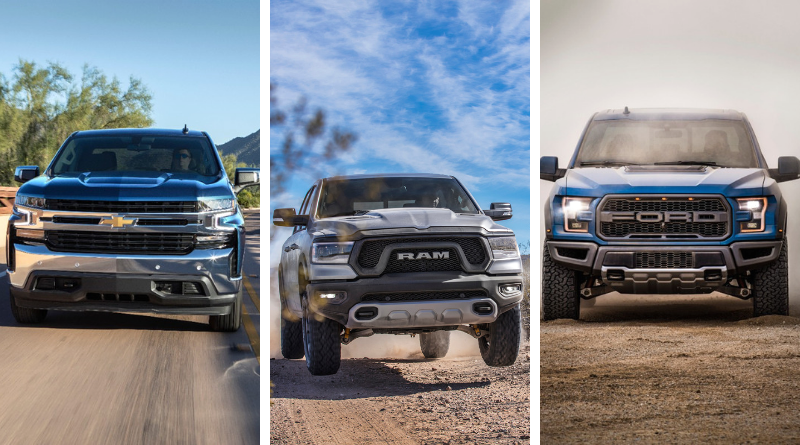
Truck Wars: The Detroit 3 Battle for Top Dog
One look at new vehicle sales and it’s clear to see that the historic muscle car competition for mo’ powah has been outshined by the current Truck Wars —compliments of the same players: The Detroit 3.
Sporting unprecedented fuel efficiency numbers and jaw-dropping towing capabilities, next-gen technology and interiors reminiscent of a luxury sedan, America’s pickup truck has undergone one helluva transformation since it entered a new century of production.
So, let’s take a peek at how we got here and, more importantly, what’s on the docket. Afterall, in these wars, to the shopper goes the spoils.
A Changing Landscape
Auto sales are down worldwide. You must know this by now, as the media continues to report it at every turn with the underlying message being one of “Caution: Recession Ahead!”
And while, overall, economic indicator lights are certainly “flashing yellow,” as Bank of America warns, it’s not necessarily time to stockpile groceries and start charging Grandma rent. As far as the auto industry is concerned, “The situation is admittedly less dire than in the run-up to the last recession,” stated Automotive News back in April, when the first worrying sales numbers started filtering in. Consumer confidence remains “healthy,” automakers continue to turn a profit, and union contracts are more flexible, “affording the Detroit 3 greater control over production today.”

And a big part of the Big 3’s production? SUVs, crossovers, and most importantly—pickup trucks.
However, the SUV market, for its part, is quickly becoming oversaturated and ultra-competitive, making it harder to turn a profit. Think tanks say no one’s even driving passenger cars anymore. And the pressure is ramping up for automakers to start producing attractive and affordable EVs with impressive range. So, what’s an OEM to do?
Build some pickup trucks and boost that bottom line.
“The dilemma for Detroit automakers is that, unlike a Tesla or another Silicon Valley company, they can’t just raise money from hedge funds and venture capitalists. They need to generate most of the money they’re spending on the future out of what they’re selling now,” Michelle Krebs, an analyst for AutoTrader, explains to the Detroit News. “Waymo doesn’t have a product portfolio to keep up-to-date. All it has to do is work on the product of the future.”
As long as pickups remain the light at the end of the financial tunnel, automakers will keep innovating. That means, the Truck Wars are going to get a little more combative. (And consumers are going to gain a little more power of choice.)
Supply & Demand
According to J.D. Power, average new vehicle transaction prices set a record during the first half of 2019, exceeding $33,000. (For truck owners, that number exceeds $48,000, according to Edmunds.) But coupled with that, are higher interest rates on auto loans, as well as longer term lengths—meaning if customers want a new ride, they have to be willing to cough up the capital.
That, in turn, has created a market in which consumers (rightfully) demand more from their (overpriced) vehicles.

Besides, if my $1,000 iPhone can book a hotel room, take professional-quality photos, and track my daily steps—all while streaming ESPN with no buffering—you bet your bottom, I expect my $50,000 pickup to sport some consumer goodies.
To their credit, the Detroit 3 have responded with enthusiasm. Offering better payload and towing ratings, nicer in-cabin appointments, and a downright stupid array of trim levels, there has never been more diversity within the pickup market.
And for those shoppers willing to forego a newer model in the hope of saving some dough?
Not only have the Truck Wars ensured there’s something for them—they can actually get some of the best deals around.
“It’s an extremely strong pickup market,” adds Krebs. “New trucks are expensive, and there are truck buyers that don’t care if they have the previous generation, and they get it deeply discounted. It’s how the game is played, and they all play it.”
FCA, in particular, plays it really well. The automaker, who continues to sell its earlier-gen model RAM 1500, now dubbed “Classic,” alongside the all-new, award-winning RAM 1500, just outpaced Chevy in truck sales—pushing the bowtie badge to the #3 spot. “Dealers say that while the Classic lacks some of the bells and whistles of its successor, it retains wide appeal among consumers not ready to absorb the higher payments of the new truck, bargain hunters scooping up generous incentives, and commercial clients who need basic work vehicles to beat on,” says Automotive News, who reports that Classic sales made up nearly a third of RAM’s total pickup sales in the first quarter.
J.D. Power adds that among all automakers, “a full 3.5% of July’s new car sales were 2018 model years,” indicating that, even though new is nice, shoppers still enjoy a good deal.

Measured Moves
It’s important to note that a sales strategy focused on pickups isn’t just a modern money grab. “Increased pickup sales net higher profits at a time when automakers are accumulating cash to fund an uncertain future of new electric vehicles and self-driving cars,” points out the Detroit News. “To that end, it matters deeply how many pickups automakers sell.” (Emphasis mine.)
Automakers may be willing and able to weather the storm of tariffs and job cuts, low sales and high R&D, but they see the writing on the wall. (And usually before the rest of us do.) Short-term profits are nice, but this is about playing the long game in a market about to be flipped on its head.
“The pickup market is now the only place where Detroit’s so-called Big Three can still claim dominance, outselling their two import rivals by over two-to-one last year,” reports CNBC. “And that’s the way Detroit’s automakers hope it will stay. Without pressure from the imports they can maintain hefty prices and the big margins that keep their balance sheets in the black.”
And the pickups delivering the biggest return? Heavy-duty, baby.
Perhaps you remember the hoopla surrounding the Chicago Auto Show back in February, when all three of Detroit’s darlings threw down the gauntlet to formally ignite the modern Truck Wars. Ford and GM debuted all-new heavy-duty pickups, while RAM—who dazzled audiences the month prior in Detroit with its all-new HD—unveiled the chassis-cab variety. You know, just in case anyone thought the automaker was annoyed that Chevy one-upped its short-lived, best-in-class tow rating of 35,100 pounds with the 2020 Silverado HD’s 35,500-lb maximum towing capacity. (Because it totally wasn’t upset. Chevy can, like, do whatever it wants, okay? Jeez.)

The Detroit 3 showed they were serious about the future of heavy-duty pickups, showcasing crazy new engine technology, redesigned transmissions, eye-popping towing numbers, and even a useless, tailgate novelty for good measure.
And did we mention diesel?? We should probably mention diesel.
Despite Europe throwing the alternative fuel out with the bath water, so to speak, American automakers seem keen to jump on board. In fact, new data from the Diesel Technology Forum indicates that diesel truck sales are up 23 percent over Q1 2019—more than double the figure for all cars and trucks in the same quarter (11 percent).
And it’s no wonder why—with trucks like the 2020 Chevy Silverado diesel on the docket. Packing an all-new Duramax 3.0-liter six-cylinder turbo-diesel unique to the model, it not only provides 460 lb-ft of torque at 1500 rpm, but is also the highest EPA-certified full-sized pickup on the market when it comes to fuel economy ratings. (Ooohwee, I think the diesel-variant Truck Wars are about to heat up, as well.)
So, let’s take a look at what each of the Detroit 3 is packing in its arsenal and how that could help determine a winner going forth.

So, who do you think will take the cake in the modern Truck Wars? Can Ford hold onto its crown, while GM and FCA battle for the #2 spot? Or will we see a take-down of America’s best-selling manufacturer? Let us know in the comments below!


