
Resourceful Traveler: Recovery Gear 101
If you don’t find yourself stuck at least once or twice during an off-road or overlanding journey, did it even happen?
As capable as a vehicle may be, part of the development process of a wheeler is tackling a trail or obstacle that is probably a bit too aggressive for our rig. Sometimes we do it on purpose, and sometimes we get blindsided. Despite dialing in our gearing, jacking up our suspension, and beefing up our tires, sometimes we just need to take our foot off the gas, throw in the towel, and get out of our vehicle. In these instances, it’s important to have the proper external equipment to ensure we escape with our dignity intact. Here at The Engine Block, we’ve compiled a list of the recovery gear you need to consider before your next adventure.
Check out our full off-road checklist for a more comprehensive rundown.
While the selections we chose below are certainly not unfamiliar to the seasoned recovery artist, it’s a good water level to jump in at for the slew of novice wheelers and ‘landers entering the hobby. In our experience, veteran off-roaders are generally a friendly and helpful bunch. They relish in using their knowledge and equipment to get the stuck unstuck. But relying exclusively on the assistance of others is a dangerous game, and self-sufficiency is a virtue on the trail.
Let’s take a look at a few hard-goods that will surely come in hand when trying to keep those wheels-a-turning.
A Note on Winches
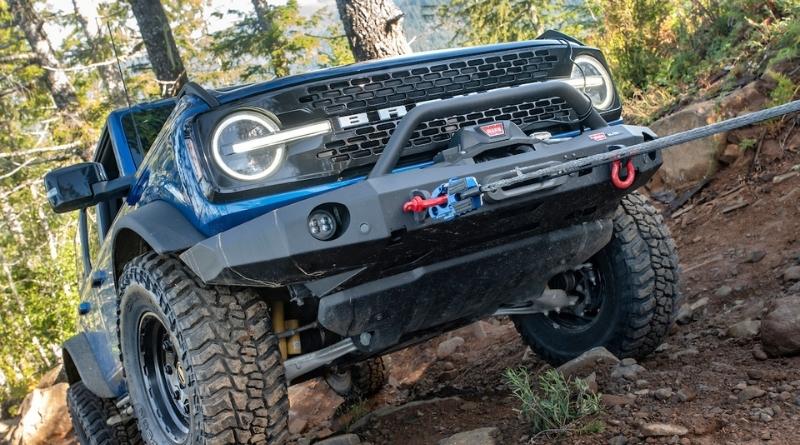
It’s the top-dog recovery piece of recovery gear, and for good reason. It’s a product, a verb, and an art form. Entire segments and manufacturers have carved their name by simply offering complementary accessories for the winch.

We could write entire articles focusing primarily on this Prince of Pulling—and in fact we have. So instead of rehashing all that’s been said, we recommend checking out our previous coverage to ensure you have the best winch for your rig:
Kinetic Recovery Straps/Ropes
Opposed to rigid winch line or stiff tow straps, kinetic recovery straps are able to stretch and store energy to assist with dislodging a stuck vehicle. Think of it like a beefed-up rubber band. As the strap reaches its maximum length it expands then contracts or snatches back to form, using its namesake—kinetic energy—to help pull out the vehicle. Most kinetic recovery straps can expand up to 30%!

Coming typically in 20-30 ft. lengths, kinetic recovery straps are great for short pulls where winching isn’t ideal or possible at all. The straps look similar to a synthetic winch rope and are typically a braided nylon construction, finished with some sort of polymer/UV coating to resist water, sunlight, and excessive fraying. For consumer 4×4 applications, rope diameter will lie somewhere around 1”, but the more important number is the breaking strength.
To ensure the best performance, make sure the strap being used has at least a rating of double the pulled vehicle’s weight—and that’s a bare minimum.
Make sure to do some research on not only what strap would work best for you, but also best practices. Using the best recovery point on the two involved vehicles is crucial for a trouble-free pull, so take your time when selecting before each usage. And even though the coating on recovery straps helps with durability, it’s essential to keep them stored properly—away from excess UV exposure and clear from any abrasion points.
♦ Recovery Gear Recs: We recommend checking out this 30-foot Power Stretch recovery rope from Bubba Rope. Custom-made for mud boggin’, it’s great for full-size trucks and large SUVs and features a breaking strength of over 52,300 pounds. If you don’t need quite that much pulling power, check out this Voodoo Offroad kinetic recovery rope. Also in 30-ft length, it features a 24,500-lb capacity — and comes in a wicked lime green nylon.
Jacks
Next to the all-powerful winch, jacks just may be the most versatile and crucial piece of kit an off-roader can possess. Like the winch, it’s big, heavy, and exudes a bit of operational danger.
While veteran wheelers know the value a little lift can bring, the jack isn’t quite as sexy as the winch and hasn’t reached its popularity level, especially amongst the novice 4×4 owner. But don’t let its price, footprint, and potential risk intimidate you. A jack can and will save your ass—even if it’s used sparingly. And let’s face it, a high-lift jack just oozes a bit of mastery and machismo when mounted to a bumper, roof, or spare tire.

When pushing the limit of what your 4×4 can handle, you will break a few things. A tire will go flat. Tie rods will snap. Gearing will grind. A jack can get that large, heavy vehicle up in the air, making it so much easier to identify and fix issues.
Plus, if you need a bit more clearance to get unstuck from that rock or stump, a jack has your back. Just remember to throw in a few jack stands along with it for safety. We recommend the Hi-Lift jack for off-road use and a floor/bottle jack when back on level ground.
♦ Recovery Gear Recs: You can’t go wrong with the Hi-Lift Jack Company, which offers the only all-cast jack manufactured in the world today — and boasts a century of manufacturing under its belt. Another trusted name is ARB whose aptly-named JACK sports some handy innovations, including hydraulic technology, an ergonomic design, and 360° adjustability.
Recovery Boards
Is that some kind of snow sled? When seeing these often brightly-colored, studded sheets for the first time, you certainly might think so.

And like a sled, recovery boards are great at getting you moving over rough terrain. They’re versatile, reliable, and easy to use and carry. While there are certainly right and wrong ways to use them, unlike the other products on our list, recovery boards are simple and fairly unintimidating to put into use.
Recovery boards are made to put in front or behind tires to give a vehicle vastly improved traction in mud, sand, snow, and other ground conditions. In softer conditions, recovery boards also help keep a vehicle from sinking too far into the earth where escape becomes more unlikely. They’re also great for giving your vehicle a bit of extra height when more clearance is needed to hurdle that huge rock or downed tree.
Recovery boards are usually made of some combination of nylon, plastic, and fiberglass and have weight ratings ranging from a few thousand to several tens of thousands of pounds per board. And like a winch or a high lift jack, recovery boards just look damn good mounted on the rack of a vehicle.
♦ Recovery Gear Recs: Smittybilt offers an aggressive option, dubbed Element Ramps. They feature a heavy-duty nylon reinforced plastic construction and can support up to 7,700 lbs. per board. If you’re looking for something a little more budget-friendly, check out Rugged Ridge’s Traction Recovery Kit, which includes two recovery tracks and a small shovel.

Soft Shackles
If you’re former Scout, dabbled in the marine community, or enjoy Metal, you’ll likely know the importance of a good knot. When sailing was in its heyday, sailors used rope and an assortment of knots to link together components of a ship. But as steel rose to glory, it replaced the soft shackle in light and heavy-duty situations.
But the tides have turned once again. Since the advent of synthetic winch rope, synthetic soft shackles have come back into favor. But these aren’t the shackles of old—modern shackles use a high-molecular-weight polyethylene construction. They come in at about ½” in diameter, are generally rated somewhere in the 30,000-40,000 lb. range, and are often coated with a UV coating to resist fraying and fading.
But there are a few even better reasons to swap, or at least complement your traditional steel rings, with soft shackles. They’re lighter, easier to store, and the added flex when pulling can greatly aid in recovery. Most importantly, if a pull goes bad and the line fails, a mass of steel won’t be shooting toward any unsuspecting bystanders or vehicles.

♦ Recovery Gear Recs: WARN’s Spydura Soft Shackle offers a durable and lightweight addition to your recovery kit, and features a 3M light activated reflective strand to improve visibility. Bubba’s Gator-Jaw synthetic shackles are a very popular and affordable option as well, and they come in a variety of colors, sizes, and breaking strengths.
For more helpful off-road and overlanding tips, check out our other Resourceful Traveler coverage.


