
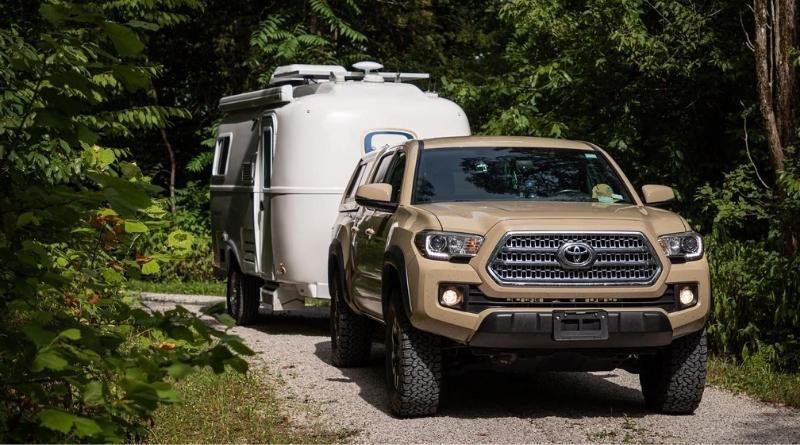
Driving Tips & Techniques to Build Towing Confidence
This article is part of an ongoing series dedicated to the basics of towing, covering topics like how manufacturers determine tow ratings, how you can properly calculate your towing capacity, and which hitch is best for your setup. Today, we’re tackling driving tips and other important towing information that will ensure happy travels on the road ahead.
For the novice driver, pulling a travel trailer isn’t quite as simple as it looks. From the configuration of the truck and trailer package to pre-travel inspection procedures, there are a number of factors to consider before one can feel confident driving down the highway in earnest. What’s more, on-road safety depends on it.
As a result, we thought we’d go through a list of core elements that lead to safe trailering. It turns out, the best way to achieve that is to start at the beginning – or in other words, starting with the type of trailer package you’re planning to run.
Categories Of Travel Trailer
Back in the immediate post-War period, there were really only two trailer categories most seen on the nation’s highways: Classic Travel Trailers, which offered space and homey amenities capable of sleeping up to 4 people; and Short-bed Teardrop configurations, which were essentially seen as campfire/tent sleeping extensions.
However, by the mid-1950s, the concept of RVing was in full bloom. This was largely thanks to the arrival of Motorhomes, which offered enhanced amenities like larger sleeping capacities, while also avoiding the need to own a separate vehicle to get the rig from one RV site to another.
This, of course, encouraged “pure trailer” manufacturers to expand their own offerings, and the market sector grew apace. Today, there are at least six primary trailer-based categories on sale in the US market.
Classic Travel Trailers

These single and dual axle configurations range in length from 10’ to 35’ feet, weighing in from between 5,000 – 9,000 lbs. In general, they offer stand-up amenities including kitchens, dining spaces, bathrooms, and of course sleeping accommodations.
Most of the time, shorter/lighter travel trailers can be pulled by sedans, light trucks, and vans. However, in the case of larger more spacious variants, heavy-duty trucks are preferable. Hitch requirements range from heavy-duty single hitches, to weight-distribution and bed integrated fifth-wheel components.
Toy Haulers
This trailer configuration is similar in terms of size, weight, and setup. However, the central living area is expanded to offer rearward garage space designed to hold ATVs, Motorcycles and other relevant toys. Again, depending on the configuration, tow vehicles can range from mid-size SUVs up to heavy-duty trucks. Hitch requirements are similar to Classic Travel Trailers.
Teardrop Trailers
These small trailers are essentially mobile sleeping enclosures. They are typically single-axle, 6’ to 10’ long, and weigh less than 1,000 lbs. The small size and low weight allows select compact cars and vans to pull them easily. Single low/medium weight hitches are typically utilized.
Stand-up Trailers
This configuration, sometimes called a “standy,” represents an expanded version of a Teardrop, with the primary advantage being additional height. Lengths and weights are similar, but the reasonable standing room offers a bit more overall volume for amenities too. Once again, small sedans and vans are compliant with this type. Similar hitch options as the Teardrop apply.

Pop-up Trailers
This option offers camping flavor with the addition of some travel trailer amenities. Overall dimensions are similar to Teardrops and Standups, although the configuration’s sail area is reduced considerably since the upper surfaces of the living area are collapsible, thereby reducing movement in windy conditions.
Overall weights range from 1,500 – 6000 lbs., and are compliant with single-hitch applications. Pull packages can extend from light truck half-tons to medium-sized sedans equipped with 4–6-cylinder engines.
Airstream
This single/dual axle variant is categorized as a Travel Trailer, but given its unique design, we feel it represents something beyond the norm. The trailer’s exterior configuration is streamlined, rather than boxy, and is identified by its rounded shape and polished aluminum finish.

Airstreams are laden with amenities and living accessories, pushing up their price tags — and weight. In general, these trailers are on the heavy side, typically ranging from 3,500 – 9,000 lbs. This means that light trucks, vans, and sedans are usually out as tow vehicles. So, if you fancy pulling an Airstream, you’ll do better with a medium/heavy-duty truck. Weight distribution hitches are also preferable.
Getting Hitched
Speaking of hitches, today’s market offers a significant number of outstanding hitch manufacturers, along with a wide-range of hitch configurations. In the case of typical RV-related trailers three primary types apply:
Receiver Hitch
This type attaches from the bottom of the tow vehicle’s underbody, and is most seen on sedans, SUVs, or light trucks; although heavy-duty configurations can handle pulling weights up to 20,000 lbs.
For example, this Class 1 receiver hitch from CURT offers a female attach point, so that the shank of a single hitch ball can be inserted in position, and locked in.
Fifth-Wheel Hitch
This unit mounts inside a truck bed, over the rear axle. It connects to the trailer via a jaw and kingpin connection, and is usually found on RV fifth wheels and campers.
CURT offers fifth wheel hitches in three distinct series with capacities ranging from 16,000 to 30,000 pounds: the articulating A-series, quiet Q-series and economical E-series.
To learn more about fifth-wheel hitches – and their agricultural cousin, the gooseneck hitch – click here.

Weight Distribution Hitch
True to its name, this configuration is designed to distribute the weight of your payload against movement of the trailer. It also actively mitigates against active trailer sway and lift. Mostly seen on pull-behind camper RVs, weight-distribution (WD) hitches are generally required when towing anything above 5,000 pounds.
CURT WD hitches come with a heavy-duty head and forged spring bars. Kits include a pre-torqued trailer ball and a sway control unit.
Issues Relating to Axle Count
When considering a trailer, you will note that we have mentioned axle count and hitch configuration when describing particular trailer types. From a drivability perspective, the reason for this is simple: stability.
In the case of single-axle trailers, the rolling moment/degree of traction tends to offer a narrow contact patch since only two tires touch the road. That means, in difficult climatic conditions – like ice, snow, or unusually high winds – this traction limitation can allow the trailer to whip sideways and drag the pulling vehicle toward the trailer’s uncontrolled movement.
If the sway is significant enough, the pulling vehicle can lose control entirely and/or break the hitch attachment, causing serious problems for the driver and involved passengers.

Practice Makes Perfect
Operating a trailer package seems to be pretty straightforward on first blush, but there are a host of odd characteristics that a novice has to accept and adapt to in real time. As long as one is pulling in a straight line, trailers tend to follow along easily as one might expect.
However, what about uneven roadways? Or grooved road surfaces, like many states where regular rain and ice conditions apply? In these cases, many Departments of Transportation purposely groove roadways in order to aid water runoff, or to enhance the bindery of salt or other ice removal liquids.
In this event, if one is running a single-axle rig, the trailer will move in the same way that the tow vehicle does – by experiencing a sideways sway. However, while the tow vehicle has a significant control advantage over the trailer here (since it is literally leading the entire package’s direction), the trailer is essentially freewheeling, offering no control of its own. Additionally, the trailer experiences slight movement lags between the time that the tow vehicle moves and the trailer does. If this kind of ‘cross-whip’ characteristic becomes overwhelming, loss of control can occur.
Dual-axle units tend to be more stable in this scenario – however, they also typically weigh more. So, the only way to resolve an issue that is entirely driven by an external and unrelated condition is to learn to experience and adapt to the way one’s particular tow package behaves. This means utilizing the tow package on a regular basis. Practice really does make perfect (along with being safer too).

Practical Tips/Traps
Just to close the loop on confidence, here are some tips and experiential scenarios that can get you started on the right side of the trailer highway.
Pre-Start Safety Checklists
Most folks look at operating a tow package as a simple process. Attach the trailer, start the vehicle, and hit the road. However, there are a number of concurrent areas of focus that must work safely to get everyone where they want to go with no problems.
That means, prior to leaving home base, one must ensure that every safety component works as advertised. This includes: mirror positioning, brakes and affiliated hoses and plumbing, all lighting systems, all vacuum systems (in the case of braking systems), hitch attachments and safety chains, plus assorted bolts, nuts, fittings, and anything else one might think of.
Do this every time you plan a trip – and ensure that if something wrong occurs along the way, you address the problem promptly.
Tire Pressures
We mention tires specifically, since those round rubber doughnuts are really the only thing between your family, the frame, and the roadway.
Tire pressures are critical. If a pressure unbalance appears, your trailer can start rocking and rolling at the wrong time, in the wrong place – like trying to climb a Colorado switchback in snow storm.
Another thing about tires relates to their condition. If you’ve spent a year running from New York to Salt Lake, then Boise to Portland, there’s a good chance you’ve earned a 10,000-mile award without thinking about it.
So, if you don’t do anything else: take care of your tires, and your tires will take care of you.
On The Go
- Elevation Changes
Just like airplanes, towing capacity decreases with altitude, along with the power of your tow vehicle. Some automakers, such as Ford or Chevrolet advise reducing gross weight by 2% per every 1,000 feet to accommodate for this change.
- Busy Highways
Depending on the highway, some drivers think they’re always running the last five laps of the Daytona 500 when they’re really just running down to the next exit for a gallon of milk. Frankly, these folks are problematic, since in terms of trailering, you already have plenty of milk in the fridge attached to the back of your F-350. So, remember you are pulling dead weight – and once you set the whole thing in motion, stopping isn’t an easy task. If you see traffic ahead, or the second coming of Kevin Harvick is trying to shoehorn himself between your tow package and the next exit, simply be cautious and slow down.
- Windy Conditions
If you’re in a wind storm, either slow down or find a sheltered location and wait it out. You’ll be happy you did.
- Heavy Rain
Same advice applies. Wait it out. You’re pulling a trailer… why not park your package and fire up your 65” HDTV? Hang loose, you’re on vacation!
- Snow
Again, same deal. Only in this case, turn on the heater. It’s cold out there!
- Narrow Passes/Mountain Switchbacks
Slow down. Don’t rush. Downshift, and maintain an even pace. In the meantime, mind the engine temps because if the incline is steep, that mill is going to be pedaling for all its worth.
So, there you go. Granted, this primer isn’t everything necessary to gain complete confidence, but you’ll be a whole lot smarter, and at the end of the day, a whole lot safer. Happy trailering!
Meet CURT
When it comes to quality towing solutions at attainable price points, CURT Manufacturing has the market cornered. The company started out with the humblest of beginnings, operating out of the trunk of a car in 1993. Today they are simply referred to as “The First Name In Towing Products.”
CURT Manufacturing offers a complete line of towing products, from gooseneck, fifth wheel, and weight distribution hitches to electrical components, ball mounts, trailer balls, cargo carriers, bike racks, and various towing accessories. With a premium towing brand like CURT on board, you can drive easy knowing that your setup is safe and secure.


