
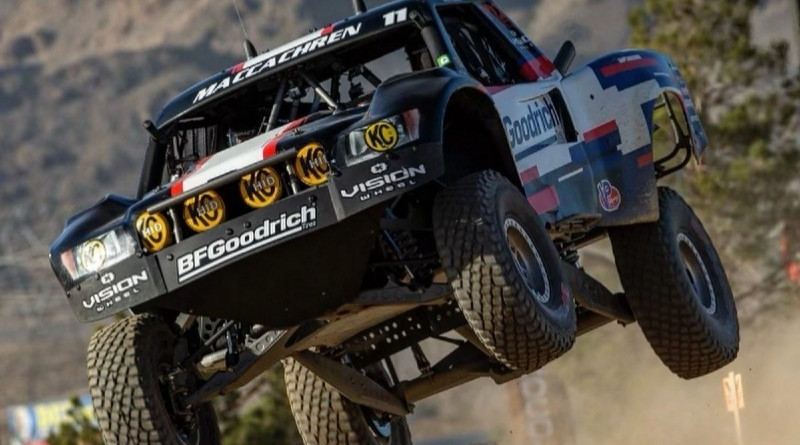
Auto Industry News: MacCachren Takes Mint 400 Victory, Nissan Goes All-In On EVs, and Honda Serves Up New-Age AV
This week spanned the gamut from tech news to classic race updates. The Mint 400 kicked off in Vegas after being pushed back from its regular March date. Nissan doubled down on EV production goals, announcing plans to invest nearly $18 billion. Honda, meanwhile, has been experimenting with autonomous vehicles for the commercial industry. And in broader news, it looks like automakers may have to source their semiconductor chips from domestic unionized labor in the future if they want in on upwards of $50 billion in subsidies.
The 2021 Mint 400 Brings the Roar Back to Vegas
This year’s Mint 400, otherwise known as The Great American Off-Road Race, kicked off last week in Las Vegas to excited crowds and roaring engines. Typically, the race takes place in March, but organizers bumped the event to December with ongoing local COVID restrictions on group events and other scheduling conflicts.
While the main event started last Friday, organizers rang in this year’s Mint earlier in the week with some exciting pre-race festivities. That included a parade on Wednesday down Las Vegas Boulevard, featuring a wild set of performance vehicles that growled and roared along the strip from Mandalay Bay to downtown Vegas.
Thursday featured the Mint 400 Off-Road Festival with a whopping 360 race teams in car, truck, motorcycle, and youth classes spread across a massive lot. Like previous Mint 400s, this year’s race was also a who’s who of celebs. Monster truck stars Cynthia Gauthier and Todd Leduc made an appearance, as did UFC fighter Donald “Cowboy” Cerrone, and motorcycle builder Jesse James.

Staging and qualifying began Friday, with defending champ Luke McMillin posting the top qualifying time (4:03:873). Second place qualifier was Harley Letner, driving for Kevin Thompson. Completing the top three was former Mint 400 winner Rob MacCachren, who recently teamed with McMillin to win the 2021 Baja 1000.
Unlimited class qualifying ran simultaneously with the O’Reilly Auto Parts Limited Race. That event saw Pro UTV Turbo driver Dustin Jones take home the overall checkered flag, after four grueling laps. While Vito Ranuio led much of the way and crossed the finish line roughly 30 seconds before Jones, corrected time placed him in second place by just under three minutes. Defending Mint 400 winner Branden Sims completed the podium.
The Main Event
On Saturday, the main event started – with Baja teammates McMillin and MacCachren the main battle contenders. MacCachren chased McMillin for the first three of four laps, accidentally making contact with only five miles left. After ensuring McMillin’s safety, MacCachren returned to the course and drove to victory with a time of 6:55:47. This is his second career Mint 400 victory since 2017.
Ryan Arciero took second place with a time of 7:02:53. McMillin, who managed to get his vehicle right-side-up, blazed his way to third place. “With 5 miles to go things got a little wild,” said McMillin. “Rob felt horrible to say the least and stopped to not only try to flip us over but nearly refused to continue on. I was upset for about 20 seconds but then proceeded to yell at Rob, ‘Go, you won this race! Go win!’”

That’s what we call sportsmanship!
Nissan Investing Almost $18 Billion in EV Campaign
While most people were nose-down in Cyber Monday deals on Nov. 29, Nissan rolled out some REALLY big spending news. The automaker said it planned to invest roughly $17.6 billion in electric vehicle production over the next five years. That’s double what the company spent in the previous decade on EVs.
This is the first comprehensive EV plan Nissan has put forward, but the manufacturer certainly isn’t new to the game. The Nissan Leaf was one of the first electric vehicles on the mass market and arguably one of the most successful. It even outpaced some other EVs at the time, like the Chevy Bolt, for its safety ratings. And in a 2020 report, Business Insider found that in 25 surveyed states, Leaf was the most popular in 18, with Tesla scooping up the other seven.
Nissan plans to launch 23 electrified vehicles with a massive rollout by 2030. The automaker also said it wants to reduce lithium-ion costs by 65% within 8 years, and produce all-solid-state batteries by 2029. Nissan’s CEO Makoto Uchida said these initiatives would make EVs more affordable and “democratize electrification.”

Even with the push towards more EV manufacturing, Nissan isn’t entirely phasing out ICE vehicles. In its announcement, the automaker said by 2030, half of its lineup will be electrified, with a mix of EVs and hybrids. By comparison, rivals like GM have committed to introducing more than 30 electric vehicle models globally by 2025, and Ford said it aimed to increase its EV production to 600,000 vehicles by 2023.
(Re)Building A Brand
With every significant automaker revamping their manufacturing structure to tap into the EV boom, Nissan’s announcement feels more like a “better late than never” update than a true bright spot for the company.
The manufacturer is still polishing up its image from movie-like hijinks by one of its former executives in 2020. You may or may not remember how former Nissan boss Carlos Ghosn attempted to escape house arrest in Tokyo by smuggling himself in a musical instrument case. Ghosn had been under house arrest for financial crimes, including allegedly funneling millions of dollars of the company’s money through a distributor in the country of Oman and into companies he controlled. Part of that funneling scheme almost had Nissan teetering on bankruptcy and forced some serious restructuring earlier this year.
Financial drama aside, Nissan’s leap into EVs could also be a profitable path forward. Its SUVs and crossovers aren’t the flashiest, and, if we’re being honest, the rental-car-quality sedans leave much to be desired. Meanwhile, its sports cars have seen more promising revamps over recent years, like the 370Z with its throwback spartan interior and the powerful, albeit overpriced GT-R.

Wild Rides
While prototypes are in the works, Nissan rolled out a few concept EV vehicles last week with its campaign news. The four vehicles dubbed the Hang-Out, Max-Out, Chill-Out and Surf-Out, range from a sporty crossover to a rugged pickup truck design.
Details are scant on what’s to be featured in each model. Still, the mockups feature roomy interiors, sunroofs, programmable LED bumpers with emojis (?), and deluxe in-dash entertainment/infotainment. The four models hint that Nissan’s trying to build something for everyone, from the off-road beach bum and the muscle car fanatic to camping families and tech heads who like to watch Netflix on the road.
If Nissan can adopt a production strategy that lets them pump out these new models without the supply chain headaches automakers are currently navigating, then they could be tapping into a new wave of buyers.
Honda Creates Friendly-Looking Work Droid
Alongside the race for electrification is a parallel push for developing autonomous vehicles. Rideshare companies like Lyft have been working on self-driving cars for their fleets, while Tesla’s forays into AV tech have led to complicated legal battles and, unfortunately, fatal crashes.
While automakers try to sort out what an average driver really wants out of AV, other studies find that some drivers don’t even know what the technology is! In a recent survey by J.D. Power, only 37% of drivers could accurately describe what AV tech is. A guarantee of safety and more education seem to be the significant determinants in bringing more drivers on board.
So, what’s the commercial market look like for these robots? Honda recently partnered with construction engineering company Black & Veatch to answer that question. The automaker tested out the Honda Autonomous Work Vehicle (AWV) at a New Mexico construction site in mid-November. Based on the automaker’s Pioneer side-by-side chassis, the AWV looks more like WALL-E on steroids or something that fell off the Jawas’ Sandcrawler than a construction vehicle.
Honda said the AWV successfully handled “towing activities and transporting construction materials, water, and other supplies to pre-set destinations within the worksite.”
Field Testing
To assess the performance of the AWV, Honda picked a solar energy construction site where support structures for solar panels were laid out in a grid pattern. This setup, Honda said, worked well for an AV since it gave the vehicle precise points along a pre-set route to stop at.
The field test also yielded positive results for the AWV’s battery system since the vehicle stayed fully functional during eight hours of working in a high-temperature environment. Towing-wise, the AWV boasted a payload of roughly 900 pounds and pulled a 1,600-pound trailer in a separate test. Currently, Honda said it’s not planning to commercialize the AWV, but that it would conduct more tests and reassess performance and design on the vehicle.
It’s tough to say whether these sorts of vehicles will be widely embraced by industries like construction, since they’d effectively eliminate jobs. The AWV, for example, charges in six hours, has a range of just under 30 miles at full load capacity and has a tow limit of 1,653 pounds. All those three factors combined mean it could potentially put in a full day’s work of hauling materials back and forth across a jobsite with no drivers needed. (No insurance or workers comp to worry about either.) But, with a labor market that’s been hurting for employees in every sector, automation might eventually be something companies turn to so they can keep up with demand.

Microchip Subsidies Could Require Union Labor
Speaking of labor… Early last week, U.S. Commerce Secretary Gina Raimondo hinted that the department might make unionized labor a prerequisite for the federal grants in the CHIPS Act. The CHIPS act is a program the Biden Administration is pitching to get the U.S. over the manufacturing hurdles worsened by COVID, including supply chain ripples and the shortage of microchips. It’s a program with roughly $50 billion in subsidies for designing and producing those chips, which could give plenty of U.S.-based automakers a leg up if they’re eligible and the program takes shape.
During a meeting at the UAW Region 1A office in Taylor, Michigan, last Monday, Raimondo said that if the U.S. wanted to compete globally, it needed to invest domestically in the semiconductor industry. She noted that domestic chip assembly currently only represents 12% of the global production, a considerable 40% drop from the 1990s.

But chips aren’t just in cars; they’re part of everything from washing machines to microwaves, so how does this push impact the auto industry? EVs need many microchips to operate – as many as 2,000 per car. So, the sooner automakers can sync chip production with vehicle production, the better off they’ll be.
Both Ford and GM pledged they’ll start working more closely with suppliers to try and get ahead of future supply headaches. Right now, though, that’s been chiefly shoring up relationships with foreign chip manufacturers. Since part of the CHIPS Act calls for building domestic chip manufacturing facilities – and the country doesn’t have an infrastructure for the product yet – we probably won’t see automakers committing to unionized domestic chip plants until they actually exist.
That sort of domestic production would benefit The Big Three and big startups.
EV startup Rivian would be one such manufacturer. The domestic, Amazon-backed automaker recently announced that it was pushing back deliveries of its R1S SUV. Originally scheduled to hit the market in January 2022, the company said it’s now projecting a May or June release at the earliest.
Rivian didn’t specify the reason for the delay, but it’s a safe bet that it has something to do with chip shortages. Having a near-shore supplier could mitigate issues like this. And it might give consumers more hope that their orders won’t be continually pushed out – or worse – canceled because of supply chain issues.

The Engine Block is your one-stop source for any and all auto industry news. Keep an eye on our weekly round-up of enthusiast coverage, product reviews, vehicle spotlights, auto show/expo features, and more. Be sure to tune in Friday for our 2021 gift-giving guide!


