
Auto Industry News: July Auto Sales Figures Are In, Entry-Level Porsche 911 Debuts, and Autonomous Car Industry Gets Some Bad PR
July auto sales numbers are in for the industry’s heavy hitters, save for the Detroit 3 who have adopted quarterly reporting. (Read on for a snapshot of the month’s winners and losers.) A closer look at the autonomous car industry is on the docket, too, as the same old challenges seem to present fresh new problems for the self-driving future. And the entry-level Porsche 911 has finally arrived—but it’s still out of our price range. Plus, Formula 1, NASCAR, and some history-making NHRA results.
July Auto Sales Winners & Losers
While it’ll be another two months until we can see the Detroit automakers’ numbers, July auto sales are in for the world’s other major players. Not having sales figures for the companies that represent 45% of U.S. sales makes the overall take a little fuzzy, but here’s a snapshot of the month’s current winners and losers.
Winners
July was a good month for many of the automakers on this list, despite overall new vehicle sales looking grim this year.
At a quick glance, Honda, Toyota, Subaru, Hyundai and its sister badge Kia all showed positive numbers for July, with SUVs and pickups largely leading the pack.
While Honda and Toyota saw their luxury badges stall, the companies’ mainstream models picked up the slack. Honda’s CR-V sold 33,656 units (2.5% up from last year), while the Ridgeline pickup saw an impressive 10% gain, marking a record month for the brand. Toyota’s popular RAV4 and Tacoma put up respectable numbers in the light-truck category as well. More surprising, however, was that car deliveries rose 3.6%, with 30,635 Corollas landing in driveways in July.

Kia took sedan sales one step further, defying current industry odds and selling more cars than SUVs or crossovers. Its sister Hyundai stayed the traditional course, with the Tucson leading the pack, while the new subcompact Kona and mid-size Palisade brought up the rear. The South Korean automaker showed a strong sales growth for July, with a 12% increase marking a full year of monthly advancements.
July auto sales at Subaru were the best-ever for the Japanese manufacturer, seeing an increase of almost 8% and marking the brand’s 92nd consecutive month of yearly, month-over-month growth.
Losers
In the not-so-hot category, we find perennial rider of the struggle bus, Nissan, joined by Mazda, Mitsubishi, and Mini.
Nissan has already announced massive employee layoffs due to monumental losses in operating budget. As the brand focuses on restructuring, sales volume dropped 9.1%. Mazda sees the 13th straight month of declining sales numbers, marked by a 3.5% slide in July alone. Sales for the Mazda3 and Mazda6 nose-dived by more than 30% as the automaker struggles to rebrand itself as a luxury badge.
Mitsubishi posted a 13% drop in July auto sales while Mini showed a 34% decline.
Fresh Challenges
While the auto industry as a whole continues to contend with changes in consumer preference, tightening emissions regulations, and rising production costs, the newest round of tariffs is bound to add a little more stress to the pile.
The President took to Twitter last week to announce the U.S. will add a 10 percent tariff on the remaining $300 billion worth of Chinese imports that had previously been exempt from duties.

Determining the effect of this fourth round of tariffs is difficult at this point in time, as trade talks continue. Regardless, the ongoing uncertainty is likely to manifest in consumer spending and corporate investment.
Tough Look for the Autonomous Car Industry
While we’re on the topic of upcoming challenges for automakers, let’s take a closer look at some recent issues in the autonomous car industry. We’ve been sold the narrative that self-driving cars are the soon-to-be way of the future, but the reality might be a bit further off than automakers and tech companies would have us believe.
According to recently-released data from AAA, more than half of all Americans think that cars will be able to drive themselves in some capacity by 2029. But a whopping 71% of that same surveyed population remain wary of being a passenger on such a ride.
“Automated vehicle technology is evolving on a very public stage and, as a result, it is affecting how consumers feel about it,” said Greg Brannon, AAA’s director of Automotive Engineering and Industry Relations. Bannon points out that baby-step technology like ADAS components help acclimatize consumers, but the survey results show that a string of high-profile incidents have laid some bad PR on the overall autonomous car industry. And one automaker really feeling the burn is Tesla.

A few weeks ago, Automotive News reported that consumer groups are calling for an FTC investigation of the carmaker’s Autopilot feature. They feel Tesla is misrepresenting the software, causing customers to put too much faith in the technology, leading to deadly accidents—such as the crash on a Florida highway last March that resulted in the death of a Tesla driver. The automaker is currently contending with the family in court.
This is a heavy blow to the entire autonomous car industry, as Tesla’s self-driving software is one of the most advanced systems available, recently logging over one billion successful miles.
Uh… Come Again?
Most recently, the industry caught some shade as news outlets responded to a New York Times article detailing how the city’s signature trend of jaywalking could make an AV-populated future disastrous. Self-driving technology can’t accurately predict random pedestrian behavior, as we’ve seen play out to disastrous effect. And while a New York City without angry jaywalkers is disturbing enough, it’s Big Auto’s suggested solutions that really have people jazzed up.
Suggestions like relocating sidewalks, offering “conservative” and “aggressive” driving modes, and—our favorite—caging in sidewalks and placing gates at each corner, “which would periodically open to allow pedestrians to cross.”
Because that doesn’t sound like it could end poorly…
All in all, it’s easy to come to the reasonable conclusion that the autonomous car industry is less of a soon-to-be launched innovation and more of a work-in-progress.
The New Entry-Level Porsche 911 is Here
Thankfully for performance enthusiasts, our robot overlords haven’t taken over yet. And for those of us who still love driving—and dream of doing so in a gorgeous, state-of-the-art, brand new Porsche, you’re in luck, as the automaker has just announced its new entry-level Porsche 911 Carrera.
Packed with the same 3-liter twin-turbo flat-six engine as its higher-trim sibling, the new base model puts out a detuned, but still impressive, 379 horsepower and 331 pounds of torque. For now, an eight-speed dual clutch PDK transmission is the only option but Porsche says a manual is on its way. However, as Motor Trend points out, “PDK shortens the zero-to-60-mph sprints quite a bit, now down to 4.0 seconds in the standard car and 3.8 seconds for Carreras equipped with the optional Sport Chrono package.”

Available in coupe or cabriolet body styles, the new entry-level Porsche 911 still sports some exciting bells and whistles. Porsche Active Suspension Management (PASM) is standard, as is the automaker’s new “Wet Mode,” which uses wheel well sensors to detect and adjust for poor road conditions. The interior remains largely the same, keeping the 10.9-inch touchscreen and digital instrument cluster as well. And outside, you’ll have to look close to spot the differences between the new base Carrera and the Carrera S. (Namely, smaller wheels and different exhaust tip design.)
Don’t confuse “entry-level” for “low price,” though. The new Porsche starts just shy of 100k—a steep asking price when the new mid-engine Corvette packs roughly 100 more horsepower for $40,000 less.
Around the Circuit
Formula 1
After a disappointing finish last week, Lewis Hamilton found himself in the winner’s circle once again, locking in his eighth win of the season ahead of Max Verstappen and Sebastian Vettel this weekend at the Hungarian Grand Prix.
Hamilton pulled off a daring move to take the lead in Turn Four, giving him and his team time for an extra pit stop and some fresh tires to close the deficit and take the lead with three laps to go.
This win puts Hamilton 62 points ahead of the pack with nine races to go, effectively locking him in for his sixth title win.
Racers will have a bit of a break coming up to recharge ahead of the Belgian Grand Prix on August 30th.
NASCAR
Chase Elliott put in another impressive shift at The Glen this weekend, finishing first ahead of Martin Truex Jr. and Denny Hamlin for his second victory of the season. The fifth win of his career and the first Chevy driver to win multiple races this season, Elliott beat out Truex in a thriller similar to last year’s win on the same ground.
Austin Cindric took advantage of a Kyle Busch mechanical failure to finish first this weekend in the Xfinity Series’ Zippo 200. Finishing ahead of Christopher Bell and Justin Allgaier, this is Cindric’s first win of the season.
Stewart Friesen locked in his first Gander Truck Series victory this weekend, finishing ahead of Sheldon Creed and Grant Enfinger. Holding off Creed by only .728 seconds, Friesen couldn’t have been more thrilled after his first career win. “Oh man, thank you to all the race fans that stuck with us,” Friesen said in Victory Lane. “Today, this is the day. This is the week. Thanks to everybody. This is meant to be.”
The Gander truck series moves to Michigan International Speedway for the regular season finale next weekend for a race on August 10, while the Monster Energy Series runs the Consumers Energy 400 the next day. Xfinity drivers head to the Mid-Ohio Sports Car Course for the B&L Transport 170 on August 10.
NHRA
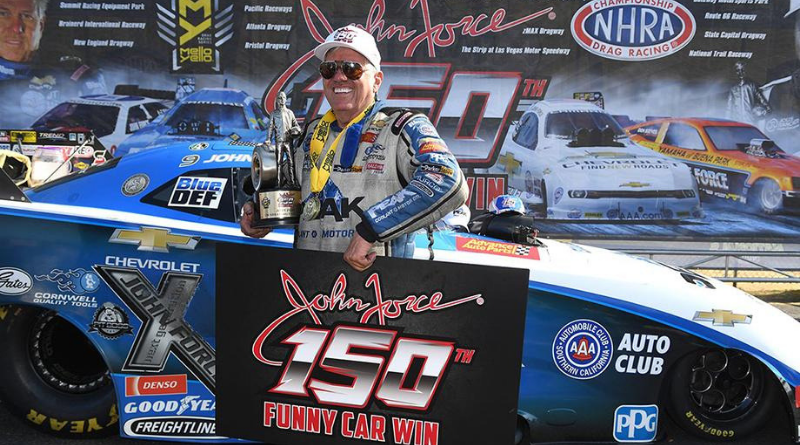
Drag racing legend and 16-time champion John Force nabbed his 150th Funny Car win this weekend at the NHRA Northwest Nationals. Fans anticipated this victory since Force took home win number 149 over a year ago in Denver.
“I may not be as young as these kids and a hot shot on that Tree, but I can still get it done,” said Force. “I’m glad it’s over and I can calm down now and not live with that—thinking you’d never get it. I know I’ve only got a few years left, I want to enjoy it. I want to have fun.”
Making the moment sweeter, Force’s protégé, Austin Prock scored his first career win in Top Fuel this weekend, as well. Prock defeated 2018 world champ and current points leader Steve Torrence in the final round.
Pro Stock saw an upset too, as Matt Hartford collected his second career win from Greg Anderson in the final round—stopping the former world champion’s historic second Western Swing sweep in the process.


