
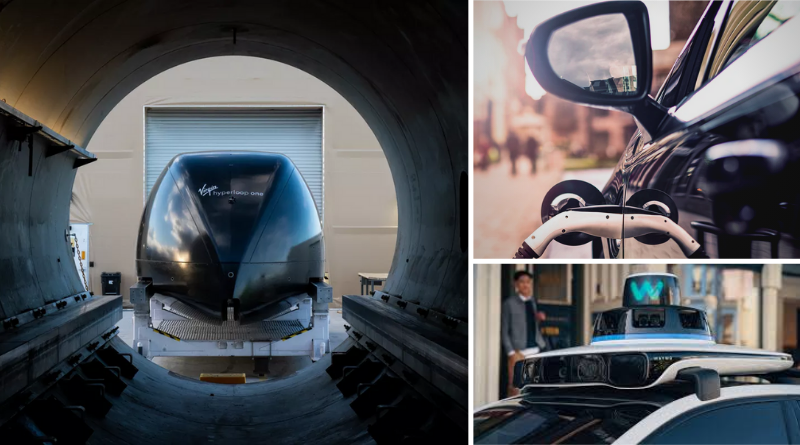
Auto Industry News: EV Market Trends and Future Technologies
Last week, The Engine Block broke down some high-level market data on current trends—particularly the boom in light truck sales. Today, our eyes turn to the future. From cool EV debuts and slightly unnerving autonomous technology, to highway infrastructure that looks like it jumped out of a Steven Spielberg film, we have quite the run-down. Plus, we rounded up some more helpful data on upcoming market trends, as well as consumer education on EV fires.
EV Market Snapshot
It’s no secret that many politicians, environmentalists, industry professionals, and yes—even some auto enthusiasts—see electric vehicles as the future. What’s more, many consider EVs not only a viable alternative to fossil fuels, but also an exciting one. While we’re not itching to wave goodbye to the purr of a V8 and the familiar smell of fuel, we admit today’s EVs are pretty impressive. Sleek styling, advanced technology, instant torque. We see the attraction—and so do many modern consumers.
Numbers-wise, EVs are holding their own in the global market. According to McKinsey & Company, global EV sales rose 65% from 2017-2018, hitting 2.1 million sales in 2018. However, that rapid expansion slowed significantly in 2019, showing a measly year-over-year sales growth of just 9%. And it should surprise no one that Q1 2020 saw worldwide EV sales decline by 25%, as most shoppers were under federal lockdowns.

New technology and supportive legislation play a big role in EV success. This is evident in Europe, where emissions standards are very strict and, as a result, 2019 EV sales rose by 44%. In contrast, the U.S. phased out federal tax credits, loosened fuel-economy standards, and is currently enjoying low oil prices, resulting in a roughly 8% decline of 2019 EV sales.
Regardless, automakers continue to churn out a diverse catalog of new electric models in the States and beyond, with many models slated to arrive within the next five years. Similarly, tech companies continue to innovate new autonomous technology, battery power, and in-cabin virtual experiences.
We here at The Engine Block rounded up some of the exciting developments in the future-auto world that we see grabbing recent headlines.
Amazon-Rivian EV Revealed
After much hype, Amazon unveiled its first all-electric delivery van earlier this month. Designed and built in partnership with Rivian, the tech giant plans to have 10,000 of the new vans on the road delivering to customers as early as 2022. A further goal seeks a total fleet of 100,000 vehicles by 2030.
Prioritizing not just electric power but also safety and functionality, the custom Amazon vans sport some interesting features. These include: 360° camera viewing for the driver, a roomy cabin, state-of-the-art sensor detection, and of course, Alexa-integration for on-demand weather and directions.

Toyota + Panasonic = A Lot of New Batteries
Auto industry giant Toyota has added battery production to its growing resume, teaming up with Panasonic to craft lithium-ion batteries for hybrid cars. Starting in 2022, the partnership is expected to yield an impressive 500,000 batteries a year.
Expect to see more joint ventures like this as a growing number of automakers look to diversify their holdings and the EV battery space gets more competitive.
Driverless Waymo Rides Opening to Public
Self-driving tech company Waymo will be offering fully driverless car service to the general public in the Metro Phoenix area. Previously, this service was only available to an exclusive group of early riders under NDA. The program will last a few weeks with service limited to a geofenced 50-square mile area. After that, safety drivers will return and the service area will expand.
“We’ll start with those who are already a part of Waymo One and, over the next several weeks, welcome more people directly into the service through our app,” says Waymo. “We expect our new fully driverless service to be very popular, and we’re thankful to our riders for their patience as we ramp up availability to serve demand.”
Oof, I think that’s gonna be a no for me. What about you guys? Would you take a driverless cab around Arizona? Let us know in the comments.
Virgin Hyperloop Heads to West Virginia
Ever wonder what it would feel like to ride in a cramped subway car that levitates in a vacuum tube and travels at 600+ mph? Well, you might just get the chance if the Virgin Hyperloop One becomes more than just a pipe dream. (Pun intended.)
Last week, the transportation technology company announced its plan to build a $500 million certification center in West Virginia. No, no—this isn’t the actual hyper-speed loop of death. This is just a place where engineers can advance the company vision for a hyper-speed loop of death.
“In a hyperloop system, which uses magnetic levitation to allow near-silent travel, a trip between New York and Washington would take just 30 minutes. That would be twice as fast as a commercial jet flight and four times faster than a high-speed train.” –Reuters
Essentially, this location would serve as central hub for testing and developing the technology to make such travel possible. According to the company, construction will begin in 2022 on the site of a former coal mine, which somehow feels poetic. The goal is for safety certification to arrive in 2025 and commercial operations by 2030.
Commercial operation for travel that is still very much theoretical, all within 10 years. Yes, you read that correctly.
Interestingly, the federal government is already getting a jump on the rule-making. Only three months ago, the Transportation Department published a regulatory framework in case such super-speedy travel possibilities do, in fact, become reality.
Hummer EV Campaign Starting, $100 Reservations Available
In a PR move that feels very “of the moment,” GM will unveil its new Hummer EV through a cross-platform media blitz. The automaker plans to debut the supertruck during Game One of the World Series, “The Voice,” and across a barrage of social media and streaming platforms, says CNBC.
Nielsen data estimates viewership could be some 255 million people. That’s more than two Super Bowl broadcasts!
The virtual event replaces an in-person event that was originally planned for May, and is a similar strategy to the online debut Ford used for its new Bronco. Such events allow automakers to connect more directly with a larger and more diverse audience than traditional auto show or media reveals.
GM’s Hummer EV SUT is one of 20 electric models GM is pushing to have by 2023, and features prominently in the automaker’s $20 billion electric and autonomous vehicle plan. The 1000-hp electric pickup will debut Tuesday, October 20 at 8pm ET. Following the reveal, reservations will open on four trims, with interested buyers only needing to put down $100 to save a spot. Production will kick off in the fall of 2021.
Electric Vehicle Fires
In 2019, around 189,500 highway vehicle fires were reported in the United States, according to Statista. And while several of them likely made some local news reports, you can guarantee any electric vehicle fires certainly made headlines. As Car and Driver neatly puts it: “electric vehicles are still a shiny new thing to many people, and when something goes wrong with them, we notice.”
Plus, EV fires are tricky to extinguish. In fact, the National Transportation Safety Board reports more than 50% of U.S. fire departments are not prepared to deal with an electric-vehicle fire, because they lack the specific training, equipment, or post-crash protocols.
It may be for this reason that recent headlines have been abuzz with EV fire news.
The Chevy Bolt EV is under investigation by the NHTSA for three instances of fires that originated without impacts from accidents. According to the Office of Defects Investigation, “Fire damage appeared to be concentrated in the EV battery compartment area with penetration into the passenger compartment from under the rear seat.”
Unfortunately, this investigation comes on the heels of Hyundai’s worldwide recall of 77,000 Kona electric cars over the risk of a battery fire. The cause of the roughly one dozen Kona fires remains unclear, with reports blaming both the battery cells and the battery packs.
Last week, BMW made a similar move, issuing a recall on 26,900 hybrid cars across its lineup because of battery fire risk. According to the NHTSA, there is not yet a remedy for the short-circuiting batteries so owners should not charge their cars. The report also states they should not drive in manual mode, sport mode, or use the shift paddles.
European Pressure
Most of the defective EVs are in Europe, where electric cars will likely triple their market share this year. Experts anticipate that in 2021, one in every seven cars sold in Europe will be a plug-in.
With such high expectations, the pressure is on for automakers to deliver attractive EVs that inspire consumer confidence. That’s a hard sell if your batteries are bursting into flames.
Ford is experiencing its fair share of this anxiety, too. The automaker recently delayed the U.S. release of its PHEV Ford Escape after thousands of similar SUVs in Europe were recalled for problems involving fires while recharging. The Ford Kuga, as the Escape is known in Europe, was withdrawn from sale in August following trouble with its high-voltage batteries. As a result, Ford of Europe will fail to meet the EU’s emissions targets and must therefore purchase emissions credits from other manufacturers to avoid harsh fines.
Europe’s strict CO2 regulations have good intentions of lessening air pollution and limiting negative environmental impact. However, we can’t help but worry that using massive fines to enforce such legislation could be causing automakers to rush imperfect products to market.


