
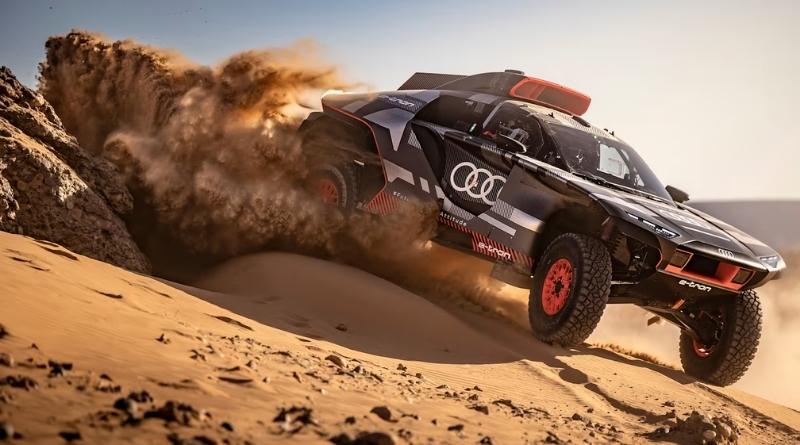
Auto Industry News: Dakar Rally Comes to Close, BMW Takes Luxury Crown, Amazon Taps Stellantis, and GM Makes Nice with California
Technology, luxury, and death-defying races all take top billing this week. BMW earned the top spot in luxury auto sales for the third consecutive year, beating Lexus and Mercedes – while also finding time to share some cool innovations at CES with a car that changes color. Meanwhile, the convergence of automotive and tech industries continued when auto parts manufacturer Aptiv said it was buying software developer Wind River for $4.3 billion in cash. Plus, Walmart and Amazon beefed up their electric fleets and GM came around on Cali’s emissions requirements.
But first… The Dakar Rally wrapped on Jan. 14, after a grueling and drama-filled couple of weeks in the Saudi Desert. The event was wrought with exciting races, severe injuries, and a mish-mash of penalties. Keep reading to learn more.
2022 Dakar Rally Brings the Excitement
This year’s Dakar Rally kicked into high gear on Jan 1. The perennial action-packed and drama-plagued event commenced in the Saudi Arabian desert, marking the third time the Middle Eastern country hosted the race. The race started in Ha’il and ended in Jeddah, traversing through the Saudi desert’s cliffs and canyons, eventually passing the coastline of the Red Sea and crossing into the dunes on the outskirts of the city of Riyadh.
The race also featured a massive sand dune area known as the Empty Quarter. The landmass of the race section is roughly the size of France and has drawn mixed responses from organizers and racers since its inclusion in the course. Some drivers consider the section better than other legs, since its sandy terrain allows for more focus on driving and less on tire punctures from rockier sections. Unfortunately, the Empty Quarter was also where motorbike racer Paulo Gonçalves died in 2020 after suffering cardiac arrest and crashing in grueling conditions.

Drama & Danger
The 2022 race also had its share of volatility, including an explosion the night before it started. The car bomb seriously injured Philippe Boutron, president of French soccer club US Orléans and a scheduled driver this year. To date, there’s no confirmation on motive, but some organizers suspect terrorism. Boutron suffered severe leg injuries and had to be placed in an induced coma before eventually being sent back to France, where he is now recovering. Following the incident, organizers stepped up security over concerns of additional attacks.
On a smaller scale, the 2022 Dakar Rally also faced a handful of driver complaints regarding road conditions and the lack of proximity to assembly points during a breakdown. Some drivers also balked at the organization’s inability to apply penalties properly, including several instances of drivers having penalties rescinded and others going unpunished.
Thrills & Spills
Despite a number of headaches, the race still produced exciting results across the board.
Big highlights included:
- Qatari Toyota driver Nasser al-Attiyah winning his fourth Dakar Rally with a time of 38:33’03.
- Nine-time world rally champion Sebastian Loeb finishing second, as al-Attiyah overtook him by 27 minutes, 46 seconds.
- Toby Price clinching a stage win after starting in 17th place, with a total time of 3.05:32 on Jan. 12.
- South African Giniel de Villiers winning the rally’s ninth stage on Jan. 11, taking his stage wins to 18. The driver also dealt with some heavy-duty fallout for hitting and destroying a motorbike, but managed to win an appeal against a penalty for the incident.
- Audi driver Stéphane Peterhansel securing his 49th stage win at the rally, pushing him closer to Finnish champ Ari Vatanen’s 50-win record.

No word yet on whether or not the 2023 rally will be held in Saudi Arabia again, but we’re sure it’ll be a non-stop thrill ride wherever it’s scheduled.
BMW Wins Luxury Sales, Debuts Color-Changing Car
Automakers may hem and haw about continued global challenges, but plenty of brands are still seeing good numbers. BMW has been on a winning streak lately, reporting last week that it toppled competitors Mercedes-Benz and Lexus. The automaker nabbed the number-one spot in luxury auto sales in the U.S. for 2021. This marks three consecutive years BMW has held the top place.
BMW beat out fellow German badge, Mercedes, by 32,705 units in the Q4 2021 and by more than 60,000 vehicles for the full year. According to Bloomberg, the gap between the two automakers was much wider in 2020, when pandemic-related shutdowns slowed manufacturing across the industry. For 2021, BMW’s deliveries were up 21%, and in contrast, Mercedes’ sales rose less than 1%.
Winning Formula
BMW attributed its promising numbers to solid sales of the X3 crossover and X5 SUV. In total, BMW delivered 336,644 crossovers and sedans in 2021, according to Automotive News. (That delivery number is on par with pre-pandemic levels.) Meanwhile, Lexus delivered 304,475 vehicles in 2021, trailing behind BMW and beating Mercedes, who delivered 276,102 total vehicles for the year.
BMW also opted to maintain its semiconductor chip orders before shortages started worsening, which helped give it a much-needed boost during 2021. BMW isn’t just resting on its laurels in that department, either. The automaker’s global sales chief Pieter Nota told Automotive News that the manufacturer entered into a direct agreement with chipmakers “to secure several million semiconductors per year.”

Now, BMW will face a new competitor in Tesla, which has perpetually upped the ante with production goals and vehicle deliveries in recent years. Last year, Tesla delivered just over 313,000 vehicles in the U.S., a 65% jump from the previous year.
Tesla’s total vehicle registrations for the first three quarters of 2021 clocked in at 230,855, putting it only 29,000 vehicles away from BMW’s registrations. But whether Tesla can hang onto that momentum remains to be seen. Just as 2022 started, the company recalled nearly half-a-million cars because of multiple safety issues, which could hamper numbers for the forthcoming quarters.
Secret Weapon
BMW also has other luxury trappings in mind… like a color-changing car??
During CES 2022 last week, BMW rolled out the iX Flow, a vehicle that allows drivers to change its exterior color with the push of a button. The car uses electrophoretic technology found in E Ink, which rapidly changes the trim color. Drivers can change the color of the entire exterior of the car or into different patterns like stripes and blotches.
Aside from a cool way to personalize your ride, Stella Clarke, project manager for iX Flow, said the color-changing effect works for practical applications, too, like changing sunlight reflection to alter the thermal properties of the car. Other applications for the color-changing effect include indicating if a battery is fully-charged, whether a ride-share car is free/open, or implementing a flashing effect for when you lose your car in a parking garage. (Which, we have to admit, is at least more courteous than setting off your alarm to make it findable.)
Big Tech Spends Big Bucks
Investments in automotive tech seem to be the order of the week. Auto parts manufacturer Aptiv recently announced plans to buy software developer Wind River for a staggering $4.3 billion in cash. The goal, Aptiv said, is to broaden its offerings as the auto industry continues to ramp up investments in digital technology. Those innovations include electrification and automation, of course, but also over-the-air software updates for system upgrades, much like how laptops and cellphones install updates.
Over-the-air updates present some significant advantages for dealers, automakers, and consumers. Mainly, they can help reduce in-person recalls as well as labor costs for associated repairs. OTA updates also make it easier for automakers to refine their vehicle technologies more frequently, instead of waiting until a new model year.
However, they also present challenges since this “virtual” update cuts down on dealers’ opportunities to recommend regularly scheduled maintenance when drivers are in-house. Since OTA updates occur over cellular and Wi-Fi signals, there’s also the ongoing concern of data breaches or malware corrupting a software system. There have been countless data breaches at the dealer and manufacturer level in the last year, including a massive hack at a Volkswagen dealer that exposed emails, mailing addresses, phone numbers, and VINs of nearly 90,000 buyers.
Still, automakers see big dollars in OTA technology and are doubling down on the service. In Oct. 2021, GM said it expected around $20-25 billion in software and services revenue opportunities “from a projected 30 million connected vehicles by the end of the decade.” That includes services like OnStar and GM’s autonomous technology, Cruise. Stellantis shared similar goals last month, saying it planned to generate $22.5 billion in software services and subscriptions by 2030. That revenue is expected to come from a combination of infotainment, GPS, and driver assistance tech.

Amazon Taps Stellantis for Electric Vans
Love ’em or hate ’em, Amazon continues to build its empire with investments in the automotive sector. In 2021, the e-commerce behemoth inked a deal with startup Rivian to buy 100,000 electric delivery vans into 2024. The company also positioned itself as a major stakeholder, as it owns about a 20% stake in Rivian. Now, Amazon is apparently eyeing Stellantis for more wheels to deliver its blue and white puffy envelopes across the country. On Jan. 5, the company announced it would purchase an unspecified number of electric delivery vans from the automaker in 2023.
Stellantis will provide its forthcoming RAM ProMaster Battery Electric Vehicle (BEV) for Amazon’s fleets, making it the first commercial customer for the van. Considering the capabilities of the new ProMaster, it could prove to be a versatile vehicle for Amazon’s fleets.
Unveiled last summer, the updated ProMaster boasts 6,910 pounds of towing capability and a 4,680 pounds of payload. Stellantis plans to offer the new van in 18 different configurations, including four vehicle lengths and two roof heights, offering plenty of space for small and large packages. (That means the new RAM could serve as the perfect solution for bulk, commercial deliveries, and those urban, last-mile deliveries of same-day packages.)
#Trending
Amazon isn’t the only retail giant stepping up its fleet initiatives. Both Walmart and FedEx said they plan to add GM subsidiary BrightDrop vans to their fleets soon. Walmart ordered 5,000 vans, while FedEx submitted an initial order of 500, with an expected 2,000 vehicles over the next few years.
While investing in electric vans is in line with many major companies’ carbon footprint goals, it’s not just about capitalizing on a buzzworthy trend. BrightDrop said the cost of charging its EVs is reportedly 75% less than fueling a gas-powered van. Across tens of thousands of fleet vans, that’s quite a bit of savings.

Carla Bailo, CEO and president of the Center for Automotive Research, said delivery companies have an ideal business case for EVs since it gives them the ability to charge during shift downtime and eliminates deadhead rides or unnecessary stops.
“I would expect to see more partnerships in this arena and continue to see more vehicle types being developed for all kinds of delivery purposes,” Bailo added. “My mantra for some time has been ‘right size and right propulse,’ and this mindset applies to public transit, ride-sharing services, and delivery services.”
GM Makes California Concessions
General Motors signaled this week that it would play ball with California’s increasingly stringent emissions standards under the Clean Air Act. The automaker reportedly sent a letter to California Governor Gavin Newsom indicating compliance with the state’s regulations. Much like retail giants opting in on EVs, GM’s move isn’t just a signal that the automaker wants to play nice and focus on carbon emissions. By agreeing to comply, GM becomes eligible for government fleet purchases by the state.
Under the Trump Administration, the automaker initially backed efforts to bar the state from setting its own emissions standards. When President Biden took office, however, GM flipped its stance. As of January 2020, the automaker said it would eliminate tailpipe emissions from light-duty vehicles by 2035. (Interestingly, California also recently proposed a goal for 100% of in-state new passenger car and truck sales to be zero-emission by 2035.)
At the end of the day, it looks like a simple case of “money talks.” The state of California hasn’t wasted time in calling GM’s bluff. In 2019, Newsom’s administration said it wouldn’t purchase fleet vehicles from the automaker because of its Trump-aligned stance. Now, both parties seem to be reaching a mutual agreement that serves business and environmental interests.

The Engine Block is your one-stop source for any and all auto industry news. Keep an eye on our weekly round-up of enthusiast coverage, product reviews, vehicle spotlights, auto show/expo features, and more. Tune in Friday for a recap of the auto industry’s ups and downs in 2021, along with a few predictions for 2022.


