
Auto Industry News: Bronco Throws It Back, Tesla Self-Driving Tech in Hot Water (Again), and American Drivers Making Bad Decisions
Tesla is back in the news this week, battling accusations of false advertising. Both the California DMV and longtime safety advocate Ralph Nader had some harsh words for the automaker, regarding its branded Autopilot and Full Self-Driving technologies. Meanwhile, lawmakers in Washington are still struggling to regulate these systems, despite the fact that self-driving taxis are already zipping around San Francisco – and keep stopping dead in the middle of traffic. And, just as these discussions about robot drivers ramp up, a number of damning reports are trickling in about the prevalence of impaired driving. From cannabis to OTC meds, it appears us human drivers are consuming some questionable things before hopping behind the wheel.
But first, Ford honors the Bronco with a new heritage edition while hiking prices on its new electric F-150.
Retro-Flavored Bronco
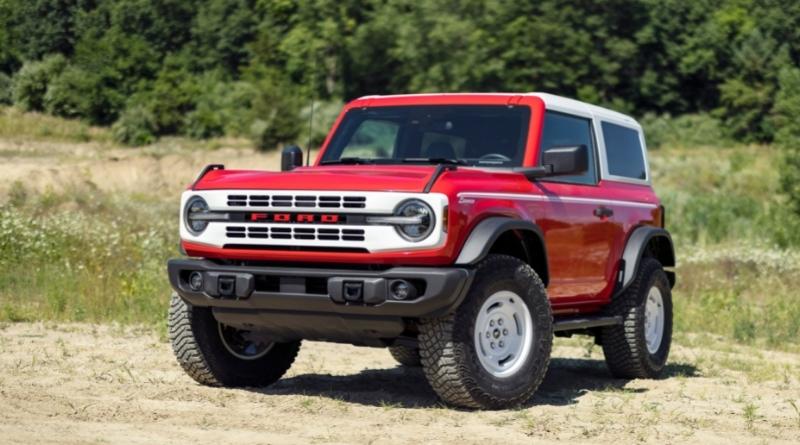
Calling all Bronco fans – Ford’s got a little something special for ya. The Bronco brand is taking trail riders back to their off-road roots with new Heritage and Heritage Limited editions.

Available across the lineup, the special-edition Bronco packages feature the classic white-painted roof, script Bronco badges, and Oxford White grille. Unique trim seats and interior details carry the retro styling inside the cabin to better capture the look and feel of classic off-roading.
Other fun details include Race Red “FORD” lettering, 17-inch aluminum heritage wheels, and a powder-coated steel front bumper with built-in recovery points and integrated fog lamps.
Based on the Big Bend trim level, the Bronco Heritage Editions feature a 300-hp 2.3-liter EcoBoost engine with your choice of a 7-speed manual or 10-speed automatic transmission. They also include the beloved Sasquatch package, which adds off-road suspension upgrades, wider fender flares, 35-inch mud-terrain tires and Dana front and rear electronic locking axles with 4.7:1 final drive ratio.
The Heritage Limited edition builds upon the Badlands trim level, offering a 330-hp 2.7-liter EcoBoost V6 engine mated to a 10-speed auto, metal “Bronco” script fender badging, leather-trimmed/vinyl plaid seats with white and Race Red accent stitching and unique Heritage Limited console badging.
In honor of the vehicle’s 1966 debut, Ford will only produce 1,966 units of each of the Heritage editions. Depending on the model, prices start from about $35,000.

Tesla in Trouble … Again
With more than three dozen open crash investigations on its resume, Tesla is no stranger to bureaucratic scrutiny. This past week, however, the automaker added two more powerful names to the list of detractors: longtime safety advocate and former presidential candidate Ralph Nader, as well as the California DMV.
At issue, is Tesla’s use of the terms “Autopilot” and “Full Self-Driving (FSD)” to describe its standard and add-on packages of advanced driver assistant features. In an official complaint filed by the California DMV, the agency argued the automaker’s promotional language overstates the technologies’ abilities.
Implying that a vehicle equipped with regular ADAS features will operate as an autonomous vehicle is untrue and misleading, the DMV said. Ralph Nader went a step further, calling Tesla’s tech “one of the most dangerous and irresponsible actions by a car company in decades,” and demanding NHTSA issue a recall.
Tesla’s major deployment of so-called Full Self-Driving (FSD) technology is one of the most dangerous and irresponsible actions by a car company in decades. My full statement: https://t.co/VsrqQLH0ZO -R
— Ralph Nader (@RalphNader) August 10, 2022
So far, the California DMV asked Tesla to change its advertising, and “better educate Tesla drivers about the capabilities” of its technologies. If the automaker does not respond to the changes within 15 days, the DMV could revoke Tesla’s license to manufacture or sell cars in the state. The agency could also require the automaker to reimburse certain customers who purchased the add-on ADAS features.
No Real Repercussions

Whether or not the bad press will lead to larger government intervention remains to be seen. Thus far, lawmakers agree: A world with self-driving cars requires updates to motor vehicle safety standards. Unfortunately, that’s about as far as our politicians have gotten. They remain completely divided on how these vehicles should be regulated and sold.
Last week, two members of the U.S. House of Representatives decided to try again. Robert Latta, a Republican, and Debbie Dingell, a Democrat, are launching a bipartisan effort to revive legislative discussions and better educate fellow lawmakers on the intricacies of self-driving vehicles.
“It’s important that we get members involved from all over the country,” Latta said, noting that legislation might not pass until the next two-year Congress opening in 2023. “This is something that is going to affect everybody.”
Watch Out
Indeed, just last month, GM and Ford petitioned NHTSA to approve special exemptions that would allow the automakers to deploy up to 2,500 self-driving vehicles each year without steering wheels, brake pedals, and other human controls.
Plus, last week, GM announced its plans to double the size of its hands-free driving network. The technology, dubbed Super Cruise, will soon be available on 400,000 miles of interstates and non-divided highways throughout the U.S. and Canada. According to Automotive News, the expanded mapping will roll out in just a few months on Super Cruise-enabled vehicles that come to the market in Q4. GM plans to offer Super Cruise on 22 models by the end of next year.

If these advancements didn’t already make it clear that a new regulatory framework is in order, then the current issues with GM’s self-driving tech company, Cruise, certainly do. We recently reported on some of the company’s technical problems in San Francisco, including one incident where more than a dozen Cruise taxis clustered at a busy intersection and blocked traffic for several hours.
According to Wired, however, it appears these snafus may be more prevalent than previously thought. A new report indicates that one evening in June, nearly 60 vehicles sat disabled across the city over a 90-minute period after losing contact with a Cruise server. Another time, in May, “the company lost touch with its entire fleet for 20 minutes as its cars sat stopped in the street.”
Losing connection with vehicles could land Cruise in violation of its California operation permits. However, as Wired notes, it can be difficult to enforce these rules when the regulations themselves “have not been tested in every possible scenario.”
Impaired Driving on the Rise
It’s no secret that many drivers feel uneasy about sharing the road with self-driving cars. In fact, a recent Pew Research study confirms the technology has a serious PR problem. Only 37% of men say self-driving cars are a good idea for society. Women have even less faith, with just 17% supporting the idea.
Regardless, most folks would agree that self-driving cars do serve as a potentially tidy solution to a longstanding problem – impaired driving. Here in America, conversations have largely revolved around drunk driving, in particular. However, new research reveals the growing role cannabis is playing in traffic fatalities.
Data from trauma centers indicated that 33% of drivers involved in fatal crashes had tetrahydrocannabinol (THC), the main psychoactive compound in cannabis, in their system – a significant increase from 21% before the pandemic. Cannabis was slightly more prevalent than alcohol in fatal crash-involved drivers (33% for cannabis vs. 29% for alcohol) during the pandemic. Impairment from multiple substances also rose the past few years, with 25% of drivers in fatal crashes testing positive for more than one impairing substance, compared to 18% before the pandemic. – Governors Highway Safety Association (GHSA)

Not Just Alcohol
Research shows that cannabis directly affects the parts of the brain responsible for attention, decision-making, coordination, and reaction time — all of which are critical for safe driving. Unfortunately, public opinion is not so easily swayed. A recent AAA Foundation survey reveals that while 95% of people agree that driving over the legal blood alcohol concentration (BAC) limit is dangerous, only 69% believe it is dangerous to drive within an hour of consuming cannabis.
As cultural attitudes and legal restrictions around cannabis use begin to ease, safety groups like the GHSA and National Alliance to Stop Impaired Driving are encouraging State Highway Safety Offices to craft better messaging around cannabis use and road safety. AAA takes a decidedly less diplomatic approach. The organization opposes the legalization of recreational marijuana, arguing it is not only an inherent traffic risk but that it also normalizes risky behavior.
AAA research also recently found that prescription and over-the-counter medications are playing an increasing role in impaired driving. In a recent survey, approximately 50% of drivers said they used one or more potentially impairing medications in the past 30 days. More concerning, many who took these medications to combat depression, pain, or sleep issues were not warned by their healthcare provider regarding the possible dangerous impact on driving.
The Engine Block is your one-stop source for any and all auto industry news. Keep an eye on our weekly round-up of enthusiast coverage, product reviews, vehicle spotlights, auto show/expo features, and more. Be sure to check back Friday for the next installment in our Resourceful Traveler series where we break down what’s better for those off-grid adventures: fridges or coolers.


