
Auto Industry News: Autonomous Towing, Electric Van Wars, F-150 Tremor Package and Hellcat-Powered Family Drives
The auto industry continues to chug along on a path of EVs and robot tech, with GM now throwing hands-free towing into the mix to keep us all on our toes. Those who still crave gas-powered off-road adventure will be happy to see Ford slap the Tremor package on its 2021 F-150. Zero-to-sixty thrill seekers should check out the Porsche build below or start saving their pennies for the new Hellcat-powered Durango that promises 11.5 quarter mile times. Plus, check out some big news about aftermarket titan Truck Hero as well as a round-up of all the high-level news you may have missed last week.
The holidays are fast approaching and times are tough for a lot of people right now. Looking for a creative way to help? Take a cue from Quarantine Cruise who hosted a toy drive and car meet in Huntingdon Beach, California. The group collected enough toys to fill a 26-foot U-Haul truck! Time’s a-wastin’, so reach out to your fellow wrenchers and see how you can help your local community today.

GM Green Lights Hands-Free Towing
It seems every automaker and their mother wants a piece of the self-driving consumer market share, including General Motors. In fact, GM is so confident in its Super Cruise semi-autonomous highway driver assist technology, that it plans to launch the 2022 Sierra 1500 Denali pickup with hands-free towing capability.
Super Cruise first appeared on the 2018 Cadillac CT6 and has continued to rack up awards, even outperforming Tesla’s Autopilot. The technology builds upon familiar Adaptive Cruise Control, using real-time GPS, a series of cameras and sensors, and LIDAR map data to detect every curve in the road. For peace of mind, a driver attention system ensures Super Cruise can only engage if the driver is paying sufficient attention.
“The technology just continues to get better with Super Cruise,” said Phil Brook, vice president of Buick GMC marketing. “It’ll be capable of towing as well, which is pretty remarkable … towing with different lengths and different loads.”

While Super Cruise also will appear on the new Hummer EV, so far only the 2022 Sierra 1500 Denali will have the hands-free towing capability. However, GM committed to putting Super Cruise on a whopping 22 nameplates by 2023, including Cadillac’s all-new Escalade, CT4, and CT5 next year and the 2022 Chevy Bolt EUV. The automaker has not yet announced whether the Chevrolet Silverado pickup will receive the self-driving treatment, but it’s a safe bet some version will appear.
Hands-free towing assistance certainly gets our attention, but we always hold a healthy dose of skepticism around autonomous technology. Although, some of the terrifyingly irresponsible towers we’ve encountered on the highway have us thinking a computer might just do a better job.
Battle of the… Electric Vans?
In recent years, the battle for highest horsepower seems to have shifted to a fight for top towing capacity. Now, with efficient delivery fleets more important than ever, could we be facing a potential Electric Van War? (It might be a dull battle by comparison, but we like to celebrate a healthy dose of competition.)
In November, Ford debuted its innovative E-Transit – the fully electric version of its best-selling cargo van. Set to arrive in late 2021, it prioritizes tech-heavy fleet management with onboard connected solutions to help drivers optimize battery efficiency and access digital services. An available Pro Power Onboard feature even allows the E-Transit to function as a mobile generator, charging job site tools or work equipment.

Starting at under $45k, Ford’s new electric van threw down a gauntlet for competitors in the space – namely Amazon and Rivian who announced a partnership to build an electric delivery van fleet. GM reportedly has an electric van in the works too. And the Hyundai-backed Arrival delivery van is set to begin sales in 2021.
However, Ford’s biggest contender seems to be a familiar one: Mercedes.
 A perennial favorite of those who subscribe to the #vanlife, the Mercedes Sprinter has also racked up cachet in the commercial market. Now, Automotive News confirms the Mercedes eSprinter – an all-electric version of the popular van – will launch in the U.S. as early as Q3 2023. Already on sale in Europe, the American version will reportedly get a larger, 120-kilowatt-hour battery that will improve its range (and competitiveness).
As companies seek more avenues for profitable EVs, fleets present a shiny opportunity. The large van segment is already a money-maker in the U.S., with Ford and GM currently controlling over 70%. Presenting fleet managers with a new way to lower operating costs is a high card to hold. Expect more automakers to play it.

Independent Engineer Builds EV Porsche Quicker Than Tesla Model S Performance
Looking for some Monday inspiration? Bisi Ezerioha, the chief engineer of Bisimoto Engineering, not only converted a Porsche 911 from gas to full electric, but also created a 635-hp smile-maker that boasts a 0 to 60 time of 2.06 seconds. (That’s quicker than a Tesla Model S Performance for those keeping score.)
Dubbed the K3V, the electric Porsche sports two battery packs creating a 32-kilowatt-hour setup. This provides Ezerioha with anywhere between 100 to 180 miles of range, depending on his driving behavior. Custom artwork and design upgrades improve the vehicle’s look and performance, including Formula E-inspired wheels and a dual-plane carbon-fiber wing.
Check out the full build in the video below.

2021 Dodge Durango SRT Hellcat
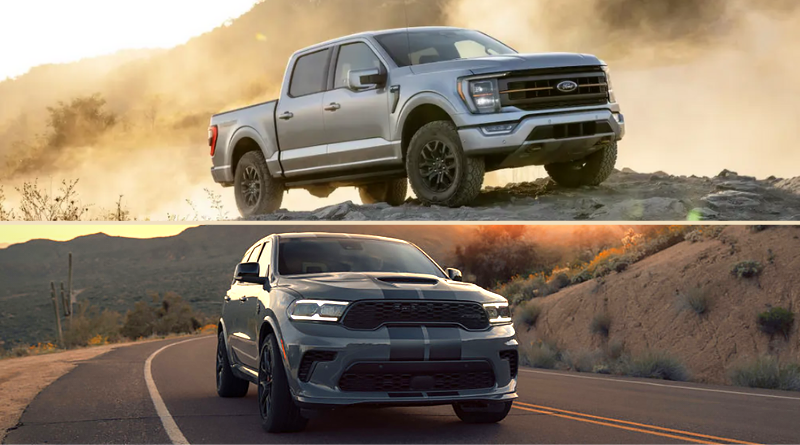
How does a Hellcat-powered SUV with a 3.5-second 0-60-time sound? Pretty good? Well, Dodge seems to agree, since it stuffed a 6.2-liter HEMI V-8 under the hood of its 2021 Durango. Pushing out 710 horsepower and 645 lb.-ft. of torque, this isn’t the average soccer mom’s three-row SUV.
Like a bodybuilder in a yoga class, this 2.5-ton family hauler boasts incredible power in a sleek, stylish, and streamlined package. Capable of towing an astounding 8,700 pounds, the 2021 Durango SRT Hellcat can also run an NHRA-certified quarter-mile elapsed time of 11.5 seconds. (Not at the same time, obviously. The maniacs in Dodge’s engineering department haven’t managed that one. Yet.)
Helping to deliver a fun drive is a transparent AWD system, specially-tuned suspension with adaptive dampers, 20×10-inch wheels wrapped in Pirelli rubber, and big Brembo brake system. A newly revamped interior keeps all passengers comfortable as their heads rear back during take-off. Exterior upgrades ensure a sharp appearance worthy of an $82,000 price tag.
If we’re being completely honest, we don’t entirely know who this vehicle was made for. Retired racecar drivers coping with retirement? “Cool Moms” who want to stand out in the school parking lot? Whoever it is, their next grocery trip will sure feel different.
More Off-Road Trucks!
While we eagerly await the new Ford Raptor to debut, the Blue Oval has served up a little something to keep us hungry – and to hopefully draw some attention away from the buzzy new RAM TRX. Ford announced last week that its off-road-truck portfolio will expand with the F-150 Tremor.
Tremor-equipped F-150s boast a 400-hp 3.5-liter EcoBoost V-6, upgraded suspension, 33-inch all-terrain tires, a rear locking diff, and a four-wheel-drive transfer case borrowed from the F-150 Raptor. The trucks can tow up to 10,900 pounds with a max payload of 1885 pounds. Like the E-Transit mentioned above, Tremors also come with an available Pro Power Onboard feature that can make 2.0 kilowatts of exportable power in the bed for tools, an air compressor or electric chainsaw.
Tremors come in three versions, each built for off-road adventures. Standard equipment includes a F-150 Raptor-style bash plate, off-road running boards, and signature exterior styling. A redesigned hood and front end give the Tremor a muscular, aggressive profile. A unique grille features a blacked-out Ford oval that is highlighted by signature Active Orange accents – a Tremor hallmark. No word on pricing yet, but speculations suggest the package should cost about $4,000.
Private Equity Firm L Catterton Acquires Truck Hero
The aftermarket delivered some big truck news of its own last week. L Catterton, one of the largest and most global consumer-focused private equity firms in the world, and its investors will acquire a controlling interest in Truck Hero. Founded in 2007, Truck Hero is the industry-leading innovator, manufacturer, and marketer of functional aftermarket accessories for pickup trucks and Jeeps.
While terms of the transaction were not disclosed, it appears that CCMP Capital Advisors (the current majority holders in Truck Hero) as well as Truck Hero’s founding CEO, Bill Reminder, will stay on as significant investors. Reminder will also retain his current leadership position.

Consolidation seems to be the name of the game these days, as the auto industry continues to face unprecedented change. We’re not sure what this new partnership agreement will look like, but the goal seems to be ensuring Truck Hero’s “next phase of growth.”
Cheers to the company’s future – and fingers-crossed this translates to fun and new aftermarket products for enthusiasts.
In case you missed it…
- The Wall Street Journal reports that about 150 U.S. dealers accepted buyout offers from GM, opting to part ways with the Cadillac brand rather than make costly upgrades necessary to sell electric cars. The skepticism suggests retailers still have a lot of questions about transitioning to EVs – as well as consumers’ interest in buying them. Read more here.
- After billions of dollars and one very high-profile hit-and-run, Uber decided to sell its self-driving research program last week to tech start-up Aurora. Uber will still keep a hand in the game, investing $400 million in Aurora as part of the deal. Wired has more on this story.
- Better look twice before crossing the street in San Francisco… GM-backed Cruise began testing driverless EVs in the city this week. Cruise received a permit from the California Department of Motor Vehicles in October, allowing the company to have up to five autonomous vehicles in its fleet without human safety backup. TechCrunch explains the details here.


