
2019 Frankfurt Motor Show Points to An Electric Future
As the world’s largest auto show, the 2019 International Motor Show or 2019 Frankfurt Motor Show or Internationale Automobil-Ausstellung (IAA)—whatever you choose to call it—is a pretty big deal. Throughout its 120-year legacy, it has seen more than a few ups and downs. And while this year may not present the challenge of an imminent world war or devastating economic depression, 2019 offers its own unique hurdles for an event celebrating international vehicle development and competition.
Let’s see… Slumping global auto sales. Trump’s trade war. Paris Climate Accord. Brexit. Electric vehicle development. Autonomous vehicle development. And we can’t forget the crowd of environmental protesters demonstrating outside the Messe Frankfurt denouncing “caRpitalism” and calling for the immediate ban of all internal combustion engines.
It’s safe to say the 2019 Frankfurt Motor Show has its hands full.
But, despite the drama and the lack of automakers (major names like Toyota, Chevy, Volvo, Ferrari, Peugeot, Citroen, Subaru, Mazda, and all FCA brands are skipping this year) the IAA has, as always, made an impression on automotive professionals and enthusiasts alike. From exciting new production cars to jaw-dropping concepts, the 2019 Frankfurt Motor Show delivers on this year’s motto: “Driving Tomorrow.”
It’s Electric, Baby
Advertising itself as “Europe’s leading platform for mobility,” should give you a pretty big clue as to what’s on the docket. Fuel-efficient, hybrid, and all-electric drivetrains are the name of the game. And this year’s IAA has them in spades.
From A-Z, here’s what we’ve found most compelling so far.
Audi
Audi pulled back the curtain on its new RS7 Sportback at the 2019 Frankfurt Motor Show, joining its already-revealed sibling, the RS6 Avant. While both share a twin-turbo V8 pushing out 592 hp and 590 lb.-ft. of torque, those who just can’t get on board with the RS6’s wagon styling should enjoy the swoopy, sporty RS7.
In line with the show’s theme, both models sport a 48-volt on-board electrical system that can help the powertrain recover energy during gentle acceleration. Additionally, state-of-the-art driver-assistance technology, infotainment services, and dynamic handling systems put a new twist on the phrase “German engineering.”

On the concept front, Audi dropped the AI:TRAIL—the fourth in its series of strange, futuristic concept vehicles. Sporting a dune-buggy-on-steroids vibe, this all-electric beast boasts 429 hp and 737 lb.-ft. of torque, and a range of 248-310 miles on paved roads, 155 on rough.
While the complete look isn’t something we expect to see in the real world, a few styling characteristics have potential. The giant windows, thanks to an “invisible” belt line, offer incredibly unobstructed views to those riding inside—a feature most would enjoy having in their full-time off-roader. Additionally, there are no dashboard screens or controls. Instead, the AI:TRAIL uses the driver’s smartphone via a steering column connection to control the vehicle, navigation, and infotainment. Considering the total lack of cohesion among automakers when it comes to dash tech, this seems like an interior feature we should have had somewhere around the iPhone 4.
BMW
Seeing as this is the 2019 Frankfurt Motor Show, it’s no surprise the Germans are coming in hot. BMW is no exception, with several new production models on display including the all-new front-wheel drive 1-series hatchback, the 8-series Grand Coup, 3-series Touring, and the third-gen X6.

It’s the Concept 4 coupe that seems to be drawing the most attention, though—especially the enormous love-it-or-hate-it kidney-shaped grille. While it’s keeping performance specs mum, BMW does say this vehicle is roughly 85% production-ready. (So, you might have to adjust to that big ol’ front end.)
Also worth mentioning is the BMW i Hydrogen Next. Based on the X5 SUV, this hydrogen fuel-cell powered concept is on brand with the German automaker’s hesitancy to put all its eggs in one future powertrain basket. The technology was developed in partnership with Toyota and is expected to launch in 2022.
Ford
While we’re unlikely to see it in the U.S., Ford revealed its hybrid compact crossover, the Puma. Debuting in the top-spec Titanium X Trim, the Puma represents the Blue Oval’s recent commitment to an electrified line-up. And while zero-emissions are great, much like Audi’s wacky lunar-rover-turned-SUV—it’s the supplementary features we found most interesting.

Sporting lumbar-massage seats (uh, yes please) with removable and washable covers (brilliant), the top-tier Puma also offers wireless device charging, a hands-free tailgate, class-leading trunk space, and beloved Fiesta underpinnings. While the “Road Edge Detection functionality” feels like nannying, we have to say we’re impressed by this seemingly-convenient little devil for the £20,000-£25,000 price range.
Honda
Ushering us into the full-EV portion of the 2019 Frankfurt Motor Show, is the “adorable” Honda E hatchback. We met the prototype in Geneva and then watched this little guy take on the Goodwood Hill Climb in July. Now, the official final-form production model is on display at the IAA, looking cuter than a puppy in a bowtie.
While tiny, urban-minded EVs usually leave us sighing in abject resignation at the future of vehicle production, the retro styling on the new Honda E helps soften the blow. With a max 152-hp, 232 lb.-ft. of torque and a range of about 135 miles, it’s not exactly getting the blood pumping, but the perfect 50:50 weight distribution, screen-heavy interior, and cameras in place of side mirrors is enough to keep us looking.
Hyundai
Speaking of all-electric vehicles with retro vibes, Hyundai debuted the 45 concept after teasing it back in August. Blending past and future in a way that looks absolutely nothing like the present, the 45 manages to be both fun and mildly unsettling at the same time. Performance specs are forthcoming but we know it sports some autonomous tech. Jury’s still out for us on this one—although we’d love to hear your take in the comments.

The new i10 made its 2019 Frankfurt Motor Show debut as well, sporting a safety and technology overhaul. The little city car set to rival the VW up! (Really, who is coming up with these names?) gets lower and wider, with a cascading grille, plenty of fresh LEDs, a new eight-inch touchscreen display, and a bevy of driver-assistance bells.
Lamborghini
Is it a true auto show without an angry-looking supercar?? The new Lambo Sian represents the Italian automaker’s first foray into alternative powertrains, using mild-hybrid technology in the form of an electric motor powered by a supercapacitor. Don’t worry, the majority of the walloping 808 hp still comes from a growly, naturally-aspirated 6.5-L V12 under the hood. That little bit of electric tech does help the Sian jet from 0-62 mph in less than 2.8 seconds, though, making it the quickest Lambo ever.
Land Rover
Offering a much-needed respite from all the tech babble, is the rugged new Land Rover Defender. While a prototype kicked off the Goodwood festivities this summer, the camouflage comes off at the 2019 Frankfurt Motor Show—and we like what we see. Keeping its traditional boxy shape (albeit with a few rounded edges) the all-new Defender has undergone a complete overhaul. Sporting a new monocoque chassis, air suspension, and 4WD system, the new Rover is also longer with better ground clearance, wearing a hoard of modern tech and a cushy, yet functional interior.

Available in both 2-door and 4-door configurations, the 2020 Defender is available with either a 2.0-L turbo I4 or 3.0-L turbo I6 making 296 hp/295 lb.-ft. of torque and 395 hp/406 lb.-ft. respectively. But most exciting? It’s coming to America! For the first time in decades, a Land Rover Defender will be available for purchase in the States. We can’t wait to see what it gets up to.
Mercedes
Like its German counterparts, Mercedes brought a long line of debuts to the 2019 Frankfurt Motor Show, including a new performance variant of the GLB compact SUV that shares a 302-hp 2.0-L turbocharged I4 with the AMG A 35 hatch.
Also drawing attention is the all-electric EQV luxury passenger van and the Vision EQS luxury sedan concept. The former is due to go on sale next year and boasts a 201-hp electric motor, 250-mile range, and DC fast charging—powering 0-80% in less than 45 minutes. The latter is meant to preview the automaker’s future flagship EV.
If the goal is “sleek, modern, and expensive-looking,” then the Mercedes has succeeded. It also stays true to that legendary German engineering, employing an electric motor at each axle that churn out 469 hp and 560 lb.-ft. of torque, rocketing the EQS from 0-60 in less than 4.5 seconds and support a range of 435 miles.
Porsche
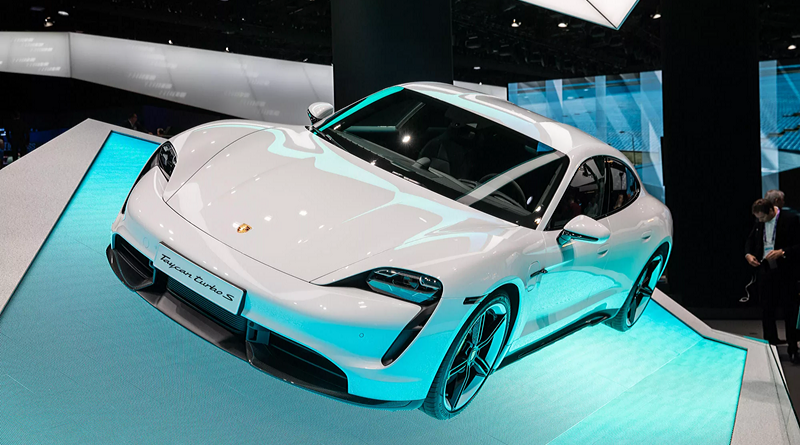
Porsche’s first electric car, the Taycan, was a heavily-anticipated reveal for this year’s Frankfurt Motor Show. Positioned as a viable Tesla competitor, the new Porsche boasts two electric motors, all-wheel drive, and up to 750 hp/774 lb.-ft. of torque. 0-60 time sits in the sub-3s with an electronically-limited top speed of 162 mph. Porsche claims range will be in the 250-mile range with a battery capable of charging from under 5-80% in about 20 minutes.

If you’ve got $150-$200k to burn, the Taycan goes on sale next year in two trims—Turbo and Turbo S.
Volkswagen
Last, but not least, is Volkswagen. Desperate to shed its Dieselgate shame, VW has brought only electric vehicles to the 2019 Frankfurt Motor Show, demonstrating its commitment to a zero-emissions future and its ID 3 agenda. Representing the third phase of the automaker’s history (one being the Beetle and two being the Golf), the flagship ID 3 has shed its camouflage for Frankfurt. Featuring an electric motor producing 201 hp and 229 lb.-ft. of torque, the ID 3 promises ranges of 205, 261, and 342 miles depending on the chosen battery as well as a starting price around $33k.
History Buff?
Curious how the Frankfurt Motor Show got to be what it is today? Read on to see why this event is more than capable of standing up to a few global crises and environmental protests.
120 Years of Auto Design
The first Internationale Automobil-Ausstellung (IAA) occurred in Berlin in 1897, debuting a whopping eight vehicles from three manufacturers. Within two years, 100 exhibitors were on board with dozens of debuts. Attendance numbers grew, vehicle development progressed, and the first inklings of a true industry began taking shape. WWI crashed the party for a few years and when the IAA returned in 1921, it was a decidedly domestic affair, celebrating the “bloodied but unbowed” German automobile industry.
This nationalistic attitude prevailed throughout the 1920s, as Germany worked hard to regain a strong foothold in a competitive international market now battling post-war anxieties and a global recession. Despite political, economic, and societal challenges, incredible innovations emerged. Front-wheel drive. Independent suspension. Crank-operated windows!

Then, in 1933, the 23rd IAA was opened by none other than Chancellor Adolph Hitler, just a mere few days after the Nazis seized power in Germany. Presenting himself as a champion of the auto industry—offering vehicle tax incentives, infrastructure overhauls, and national motorsports events—Hitler positioned the show as a bastion for Nazi propaganda. Extensive, state-funded advertising helped draw unprecedented crowds, the largest being in 1939 with a record 825,000 visitors. (For perspective, that’s 50k more people than attended this year’s Detroit Auto Show.)
I don’t think I need to detail the absolute havoc that WWII wreaked across Europe. Suffice it to say, the IAA didn’t return as a fully-formed event until 1951—at which point, Germany was now split between two global blocs. The country’s auto industry decided Frankfurt should be the official and permanent home of the show, which would take place every other year. The current format of passenger debuts on the odd-numbered years and commercial vehicles on the evens, came about in the early ‘90s when the show’s popularity ballooned, outgrowing its exhibition site.


